Reserva Ciudad

Description

Madrid 2009
Description
Poster
City Archive
Jacket for two
Tours
Maps
Press
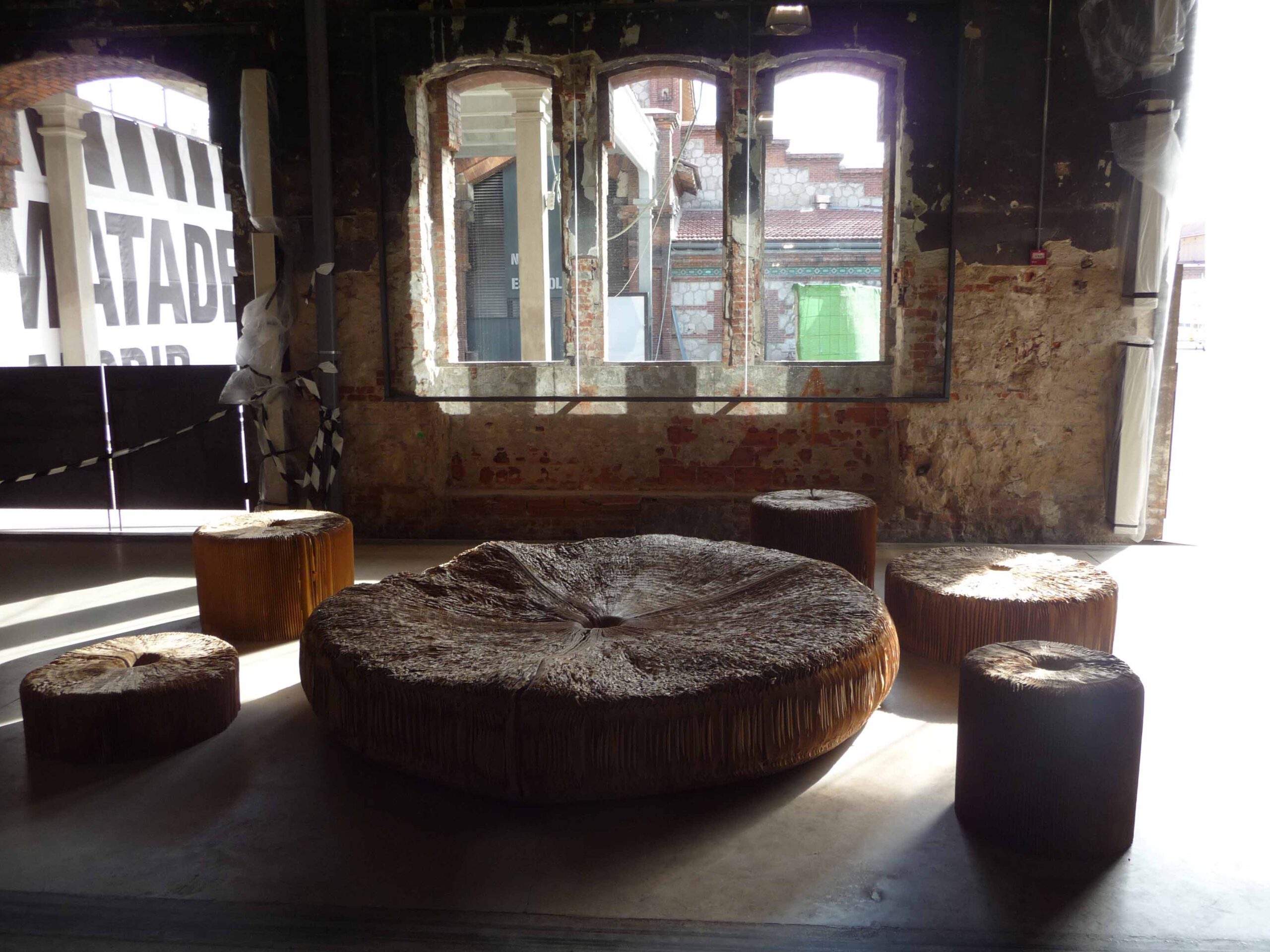
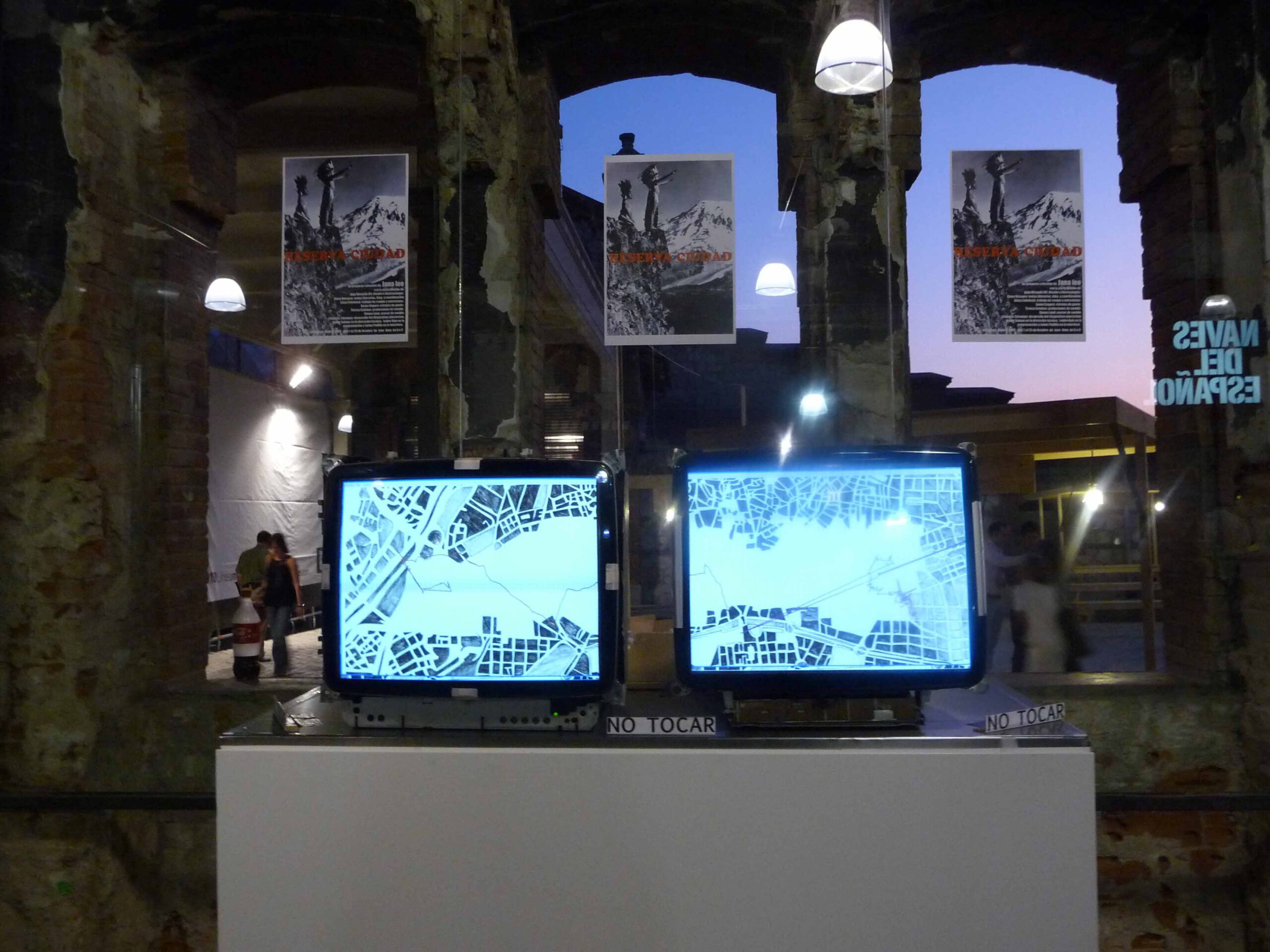
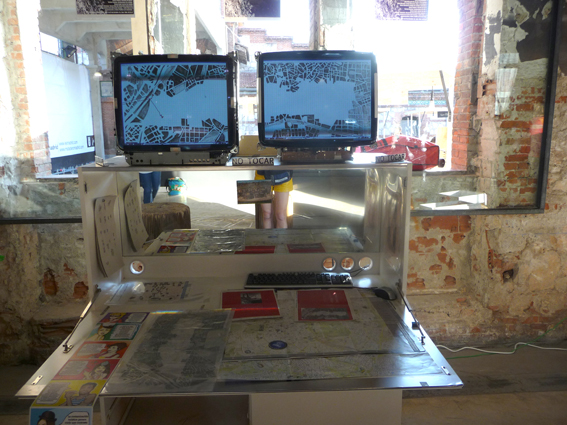
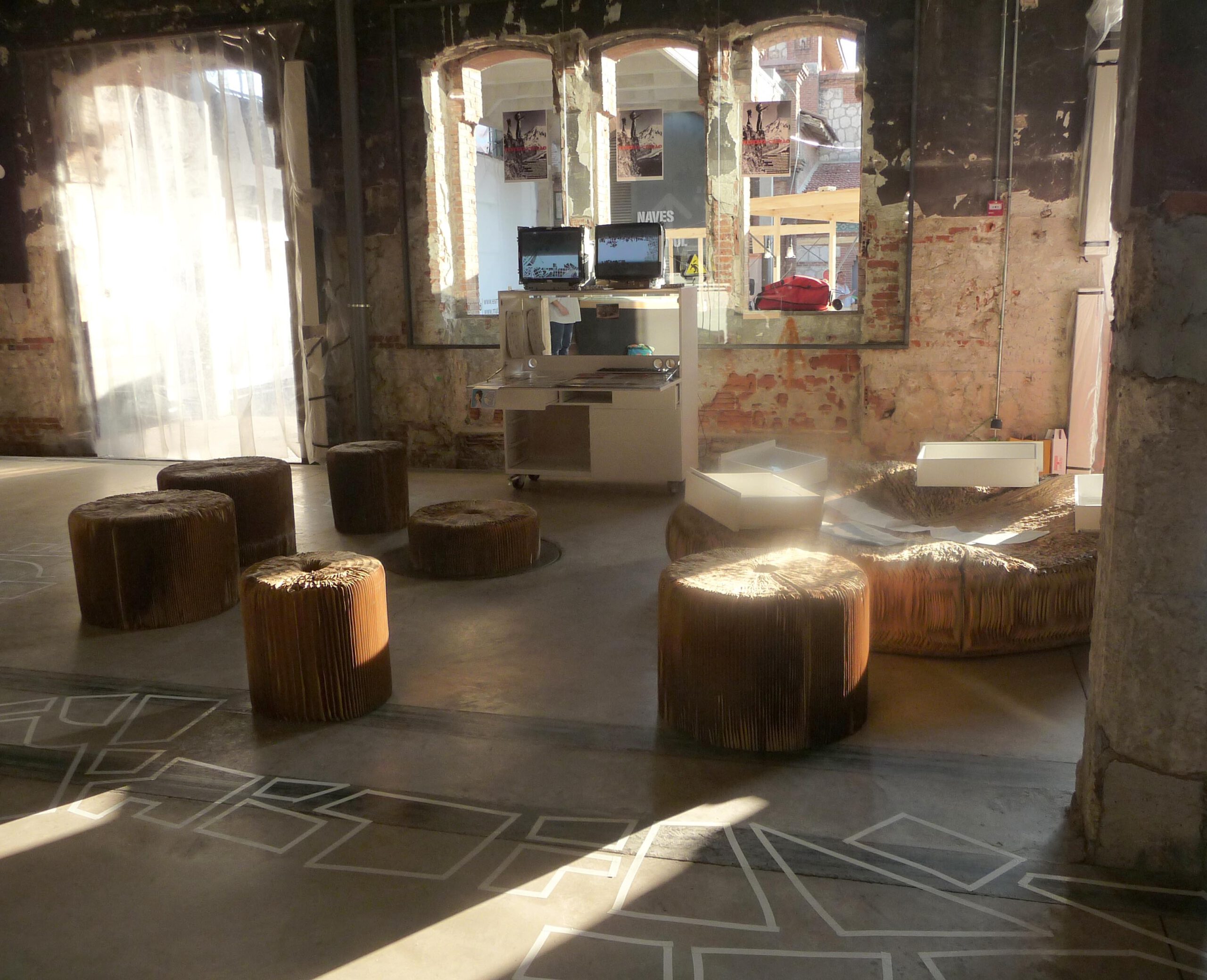
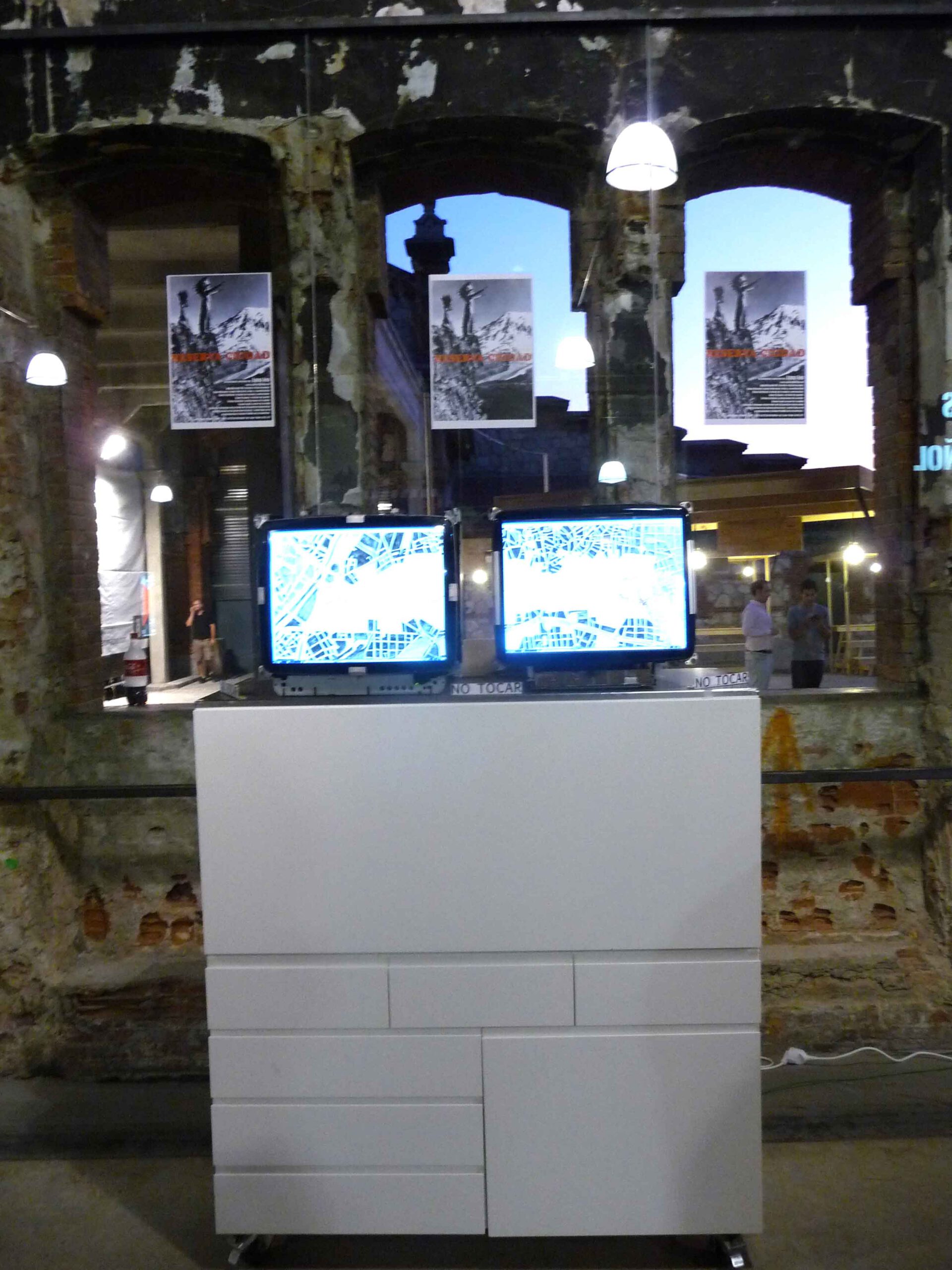
Staging in Matadero
Barcelona 2011
Description
Card
Program
City Archive
Jacket for two
Tours
Maps
Press
Staging in Barcelona

Reserva Ciudad

Summary
City Reserve deals with the intellectual and the existential in the life of a city. The basic objective of the project is to improve the intellectual and existential aspects of the urban environment by making cities culturally richer and discovering the ecologies of the immaterial. Using a combination of artist-led tours, archives, maps, and the publication of a book, the project seeks to make visible the importance of those aspects of the city that are often overlooked by other forms of urban entertainment and cultural production—aspects of an ecology of the immaterial.

Project history
The project began in 2006 following discussions between Gabriel Park and Jana Leo regarding the changes occurring in New York City. Library visits and subsequent research into the origins of the nature reserve revealed that it was first created in the United States and thanks to an artist. The hypothesis arose of the city center as a protected site, a city reserve, whose classification has more to do with the ecologies of the natural world than with protection regulations for buildings or neighborhoods. It was thought that conceiving an urban nature reserve is the role of visionaries, the artists; putting it into practice is the task of policy makers, the government. Actions translating these ideas into artistic practices were first tested at Matadero-Madrid in 2009. There, a large part of the elements seen in later editions were CNCeived and developed. Now, the City Reserve project seeks to extend these preliminary investigations to a larger scale, hoping to articulate an understanding of what a city is today.

Concepts: city reserve mental city preserve ecology of the immaterial the image it projects cultural tourism

Methodology

Vehicles. Putting concepts into practice: tours, maps

texts by Jana Leo; editing of ideas by Sony Devabhaktuni

***

Project concepts, city reserve

If the designation “Nature reserve” is a way to preserve the natural beauty of a landscape by protecting it from further exploitation, the delimitation “city reserve” could be interpreted as a way to protect mental activity to prevent “the civic” from being subdued, and cities from becoming merely a place of consumption: the city viewed as a large public square (not just a crowded place), an intellectual park containing both, with all the chaos and freedom of the mix. “City reserve” applies the concept of a nature reserve to the city, resulting in the preservation of the immaterial—the essence of the urban environment—through art. A web structure documents and manages the artistic actions. A partner, Espai Cultural Caja Madrid in Barcelona, puts these artistic actions into practice.
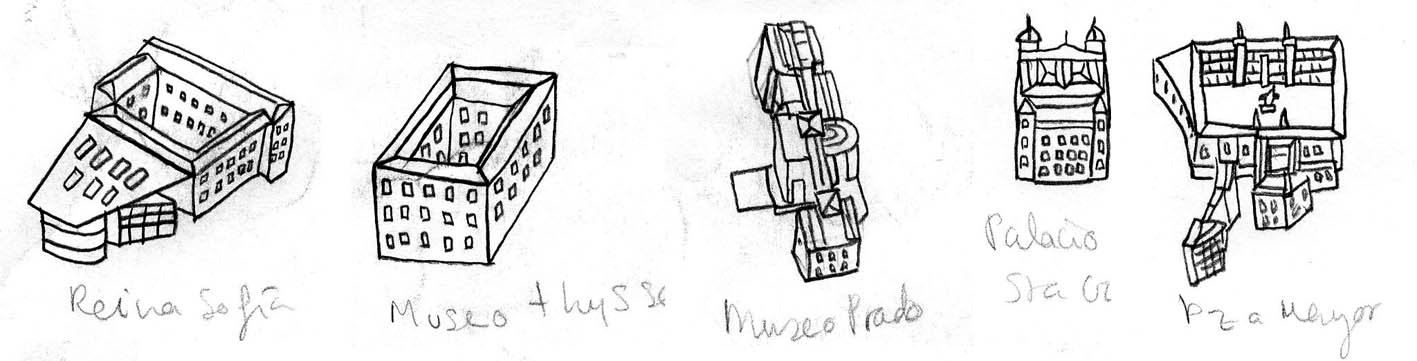
Project concepts, mental city

It is widely recognized that a city is a commercial and service center for a broad population. What is not recognized is that mental and abstract activities also define the city. In addition to offering more opportunities (better jobs, education, visa conditions, access to everything) and entertainment, cities are places to think (humanism in a broad sense, a place where memories of past events gather, new ideas spread, and lessons are shared) and to experience (encounters between individuals, being part of something larger). Cities are the “gray matter” or the “mental reserve” of a country and the world. Since this mental reserve is always in danger of extinction, it needs to be preserved. This intellectual life can be understood as that part of the urban landscape that is immaterial and/or goes unnoticed. The “culture of experience” should not be industrialized and sold as a tourist package, but rather appreciated in a slow unfolding made visible through the small variations of daily life in a city that build upon each other and can only be revealed by registering partial differences.
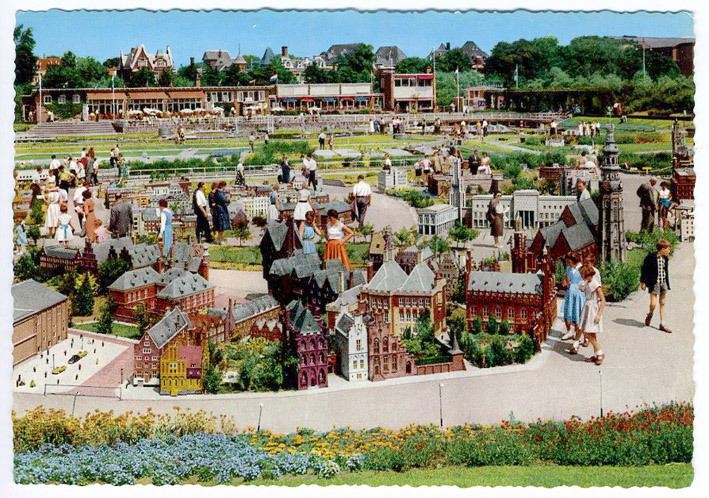
Project concepts, preserving a city

When looking at what is commonly preserved on a large scale, two cases come to mind: the rehabilitation of historic centers and the nature reserve or wildlife sanctuary. What is preserved are physical things: a forest, a building, a group of buildings, a tree as a natural monument, a waterfall, a beach. However, while the reserve or nature reserve tries to maintain species and communities (one cannot imagine preserving a type of bird without also protecting its natural habitat), historic preservation often focuses on individual objects or buildings. There are no models for maintaining the existence of things that lack obvious material form, such as: participation in a public square, the atmosphere of the city, the degree of civility—things that are directly connected to the architecture that supports them.

Project concepts, ecology of the immaterial

If we apply ecology to the city, the result is that cities, besides being economic, social, and cultural hubs, are the places from which to question what civilization is. Ecology has been applied to the material but not to the immaterial. Sorting garbage to facilitate recycling or using reusable bags instead of plastic ones for shopping has no equivalent in immaterial ecology: removing trends and what celebrities think from personal decision-making, acting instead on lasting principles; an argumentative thought process that removes the ephemeral. Thinking is sorting and deciding. By paying attention to what is truly crucial to human existence, meaningless words are rejected. Applied to architecture, this can mean resisting the erection of buildings that merely cover squares and streets without giving anything back. Ecology applies to objects, making them durable, longer-lasting, and reusable, but it does not apply to thoughts, making them clarify existence, generate vitalism, and bring progress. Ecology is not about subtracting, but about adding. We try to reduce our waste and product use, but by not being aware of the entire cycle of ideas and principles, we use others.

Project concepts, the image the city projects

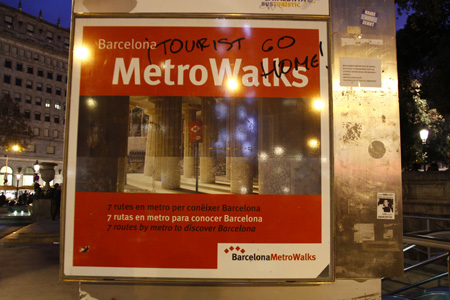
A city contains life, it has a social structure and different communities. The extension of its material elements (architecture, monuments, urban structure, educational resources) along with its immaterial elements (the atmosphere, or the urban environment, its stories, and its myths) are projected through films, novels, photographs, songs… sharing the city with those who do not live in it. What is shared is mostly the abstract element of the city: its projection. However, more effort is put into developing the physical elements of a city than its projection. The consequence is offering a reduced version, a stereotype of what a city is. When rethinking the image a city projects, it is necessary to support practices that offer a sophisticated approach (art, writing, and architecture) rather than those offering a linear reading (TV, advertising, blockbuster cinema). City Reserve reflects on the destabilizing effect of tourism on the city: historic centers and monuments are preserved without giving the same attention to the daily rituals of the place. This project integrates residents with tourists, avoiding the arrogant contempt toward tourists along with their simultaneous exploitation. We are all tourists.

Project concepts, cultural tourism

When thinking about cultural tourism, we start from the tourist as an individual and not from tourism as an industry. Exploitative tourism exploits the tourist (who does not return) and/or the city (which ceases to be desirable). The principle is that if cities are culturally rich, they naturally become a priority destination for tourism. By understanding culture as the set of overlapping actions that create a way of life rather than a list of events, from an economic standpoint, to increase a city’s cultural tourism it is necessary to invest in the city in general as an entity and not just in cultural activities. On the other hand, we must not only account for direct tourism revenue but also evaluate the losses that misunderstood tourism causes to that city. If tourism only wears down and does not generate, in the long run, the object of the industry becomes extinct and ceases to be productive. City tourism in recent years has stood out for visits to its cultural landmarks, but the life of the city itself has been left out of the visit. Tourism is considered an activity with cultural value.

Methodology

Instead of proposing to halt development or cultural production, our approach consists of inserting actions that provoke a rethinking of production and activate the city as a mental entity, intensifying the immaterial and the urban environment. These actions can be described as “vehicles”; they are practical steps that mediate and translate, describing a process that articulates the idea of the City Reserve and ultimately rethinks cultural activity with respect to the city center, which can influence the way urban planning, urban preservation, and cultural tourism are conceived.

In the same way that the environment department regulates a space as a nature reserve, for the city reserve to exist on a real level, it would have to be regulated by the government at a national level. Literally, the preservation of the environment and the immaterial wealth of cities is a political issue that must be resolved through urban planning and economic measures, not through art, architecture, or thought. However, art, architecture, and thought pave the way for change. From our position and with our means, what we do is treat the city as a project site.

October 1 to 25, 2009

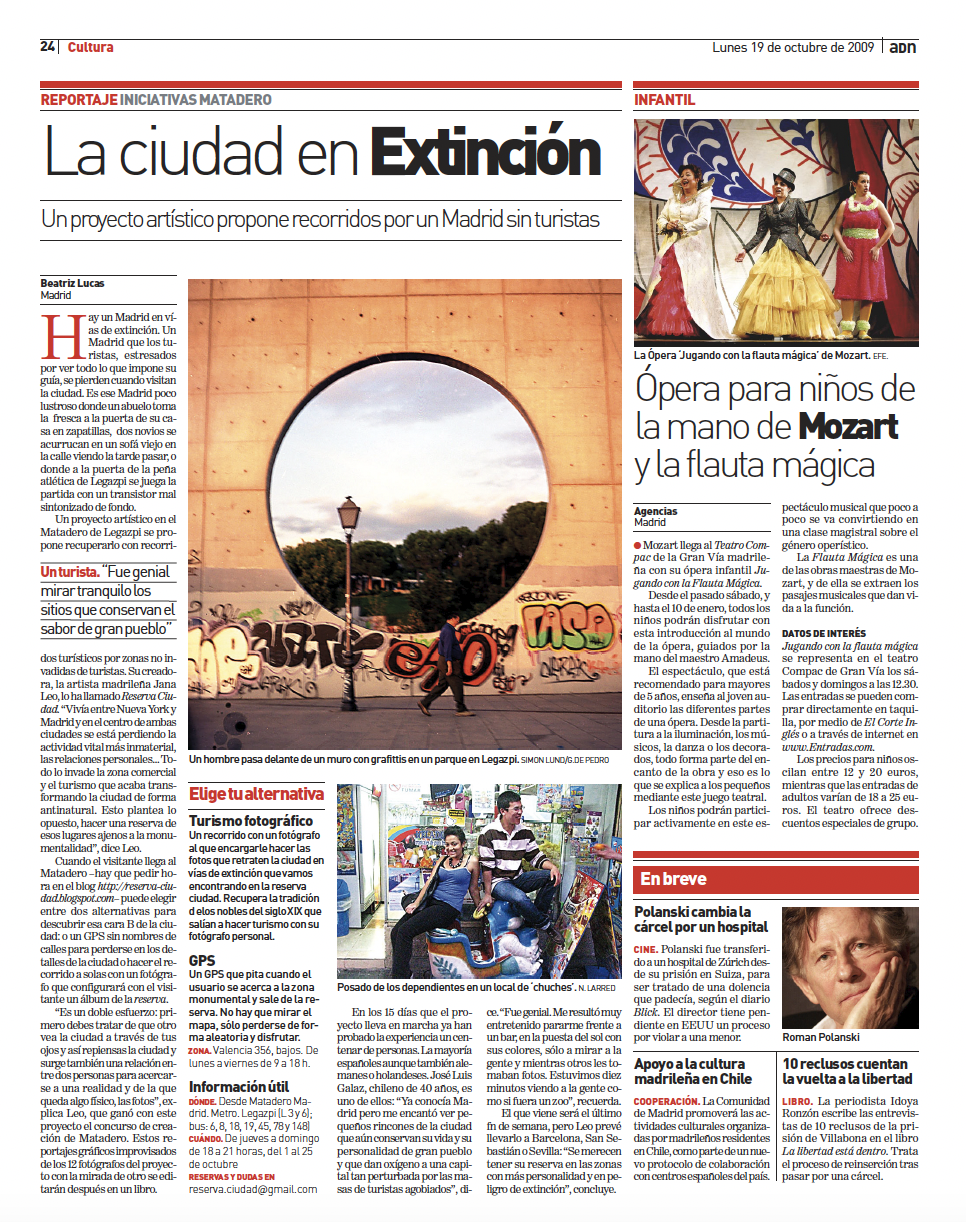
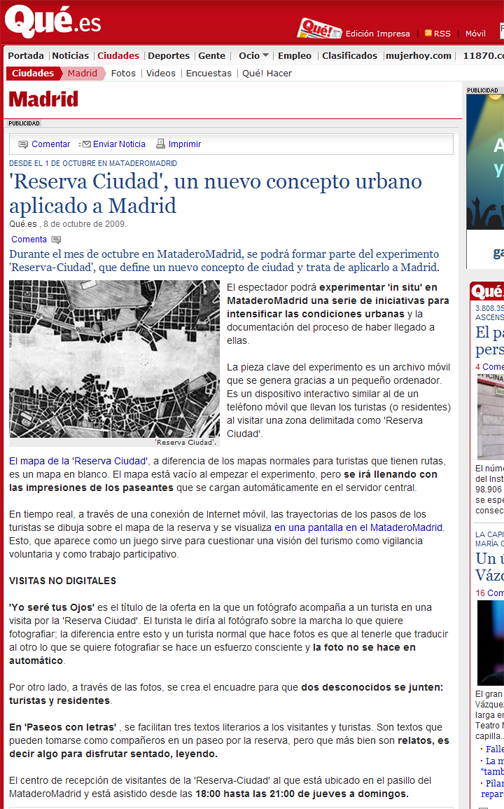
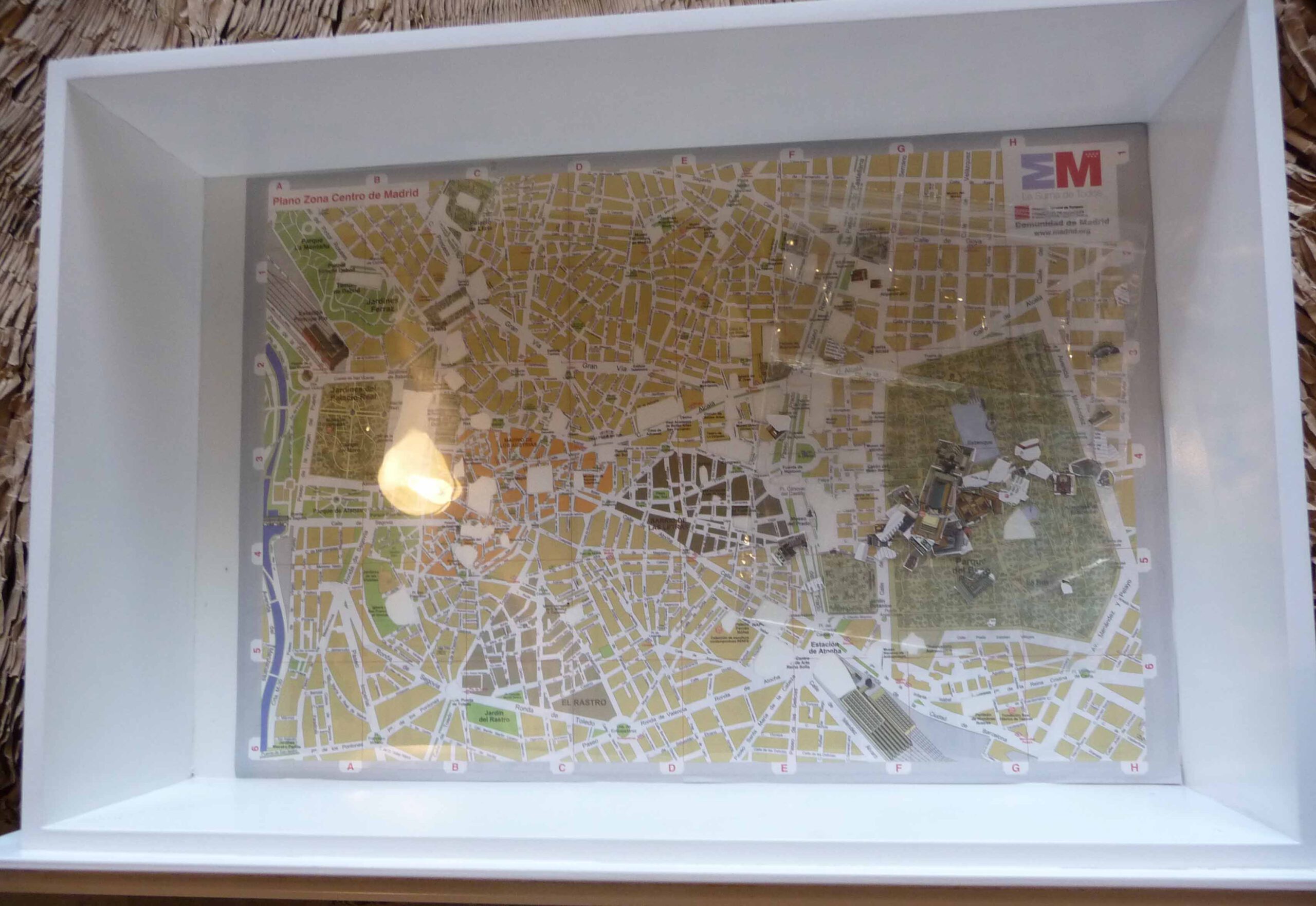
During the month of October at MataderoMadrid, it will be possible to take part in the “City-Reserve” experiment. “City-Reserve” defines a new concept and attempts to apply this concept to the city of Madrid. What we will see at Matadero is an “in situ” experiment and not an exhibition. A series of initiatives to intensify urban conditions and the documentation of the process of arriving at them, as well as the daily (fresh) material during the visits, constitute the material of “City-Reserve” open to the public on October 1st.

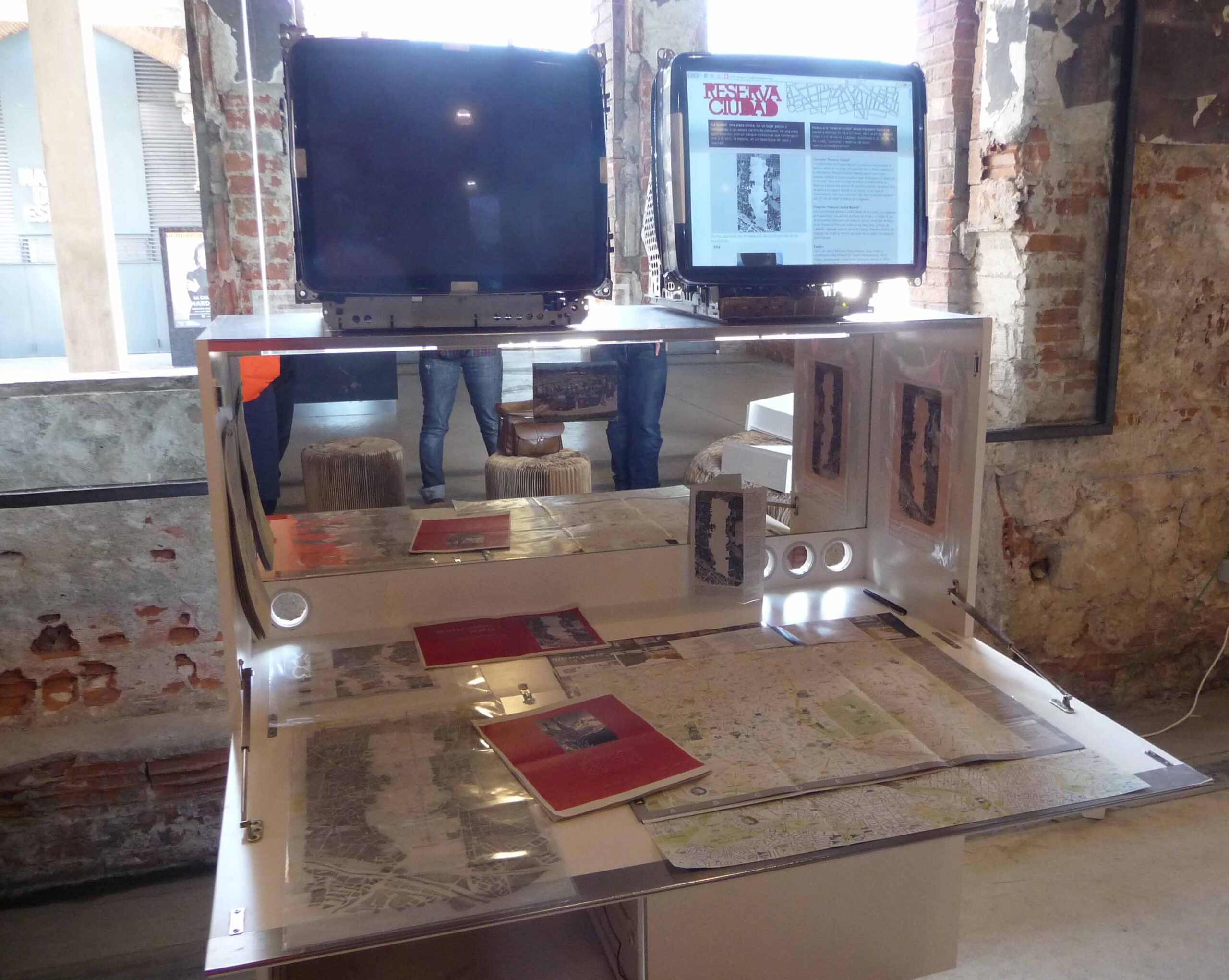
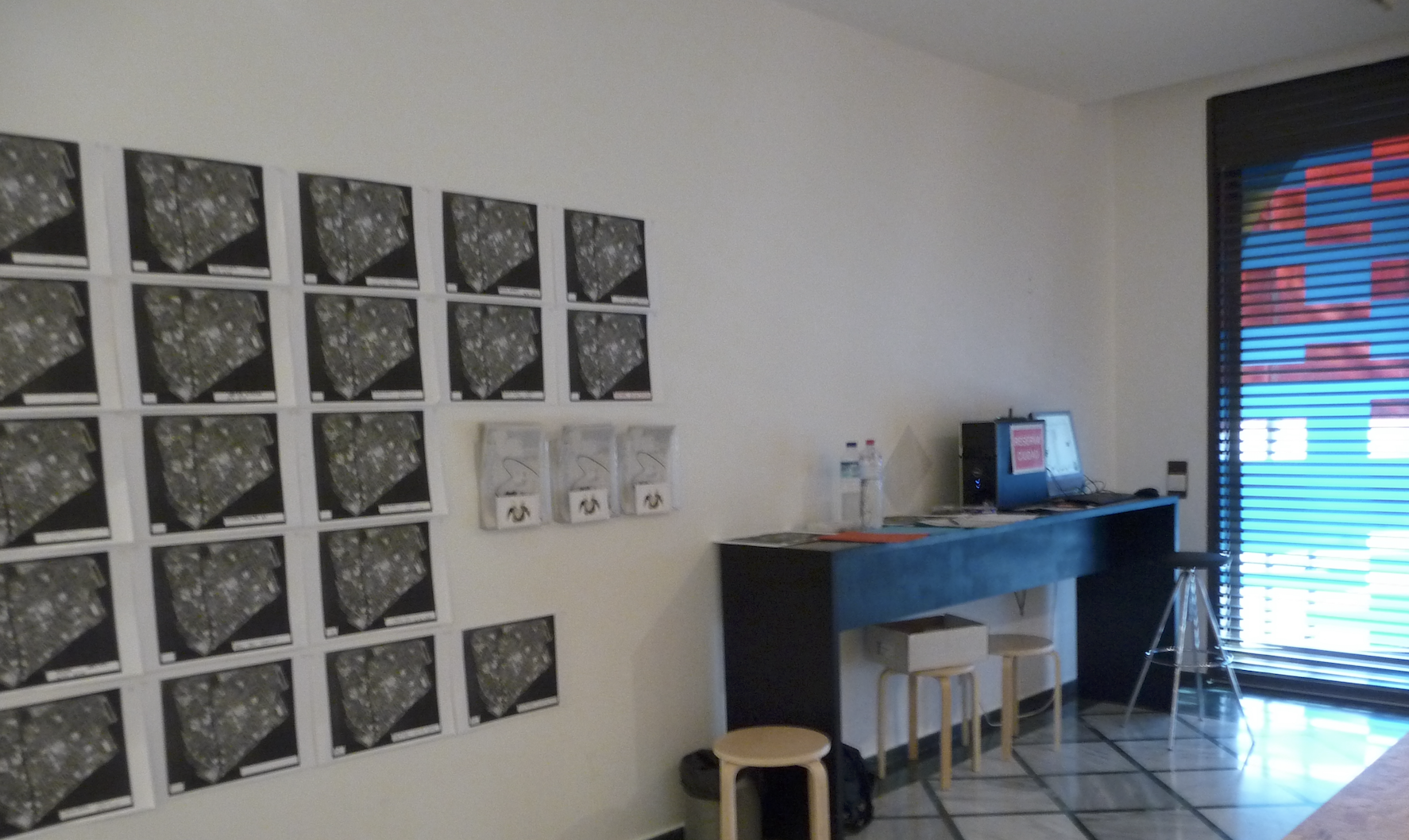
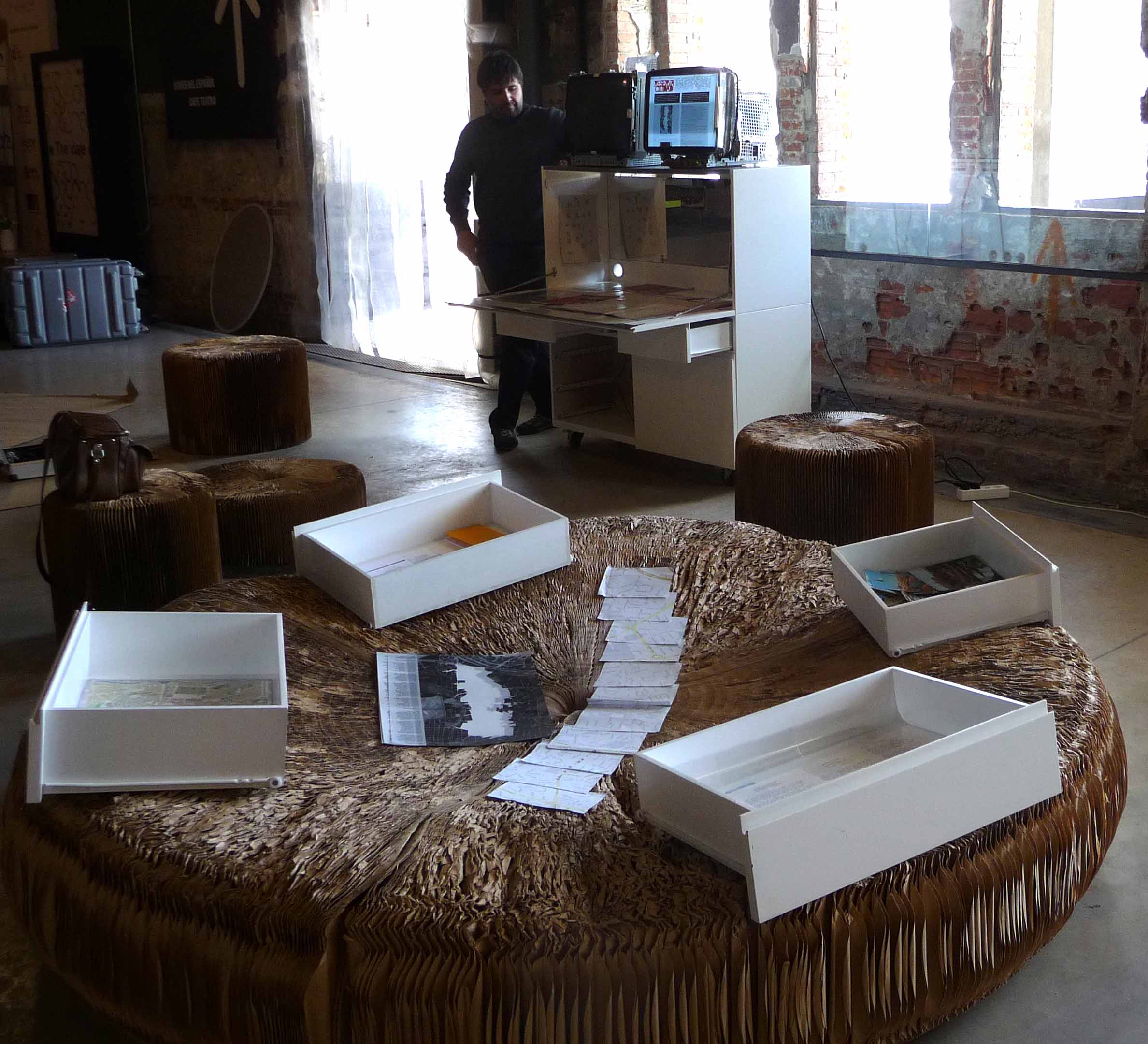
The visitor reception center for the “City-Reserve”, which could also be referred to as an information booth or documentation center, is located in the corridor of MataderoMadrid and is attended from 6:00 PM to 9:00 PM, Thursday to Sunday.

The key piece of the experiment is a mobile archive generated by a small computer. It is an interactive device similar to a mobile phone carried by tourists (or residents) when visiting an area delimited as a “City Reserve”.

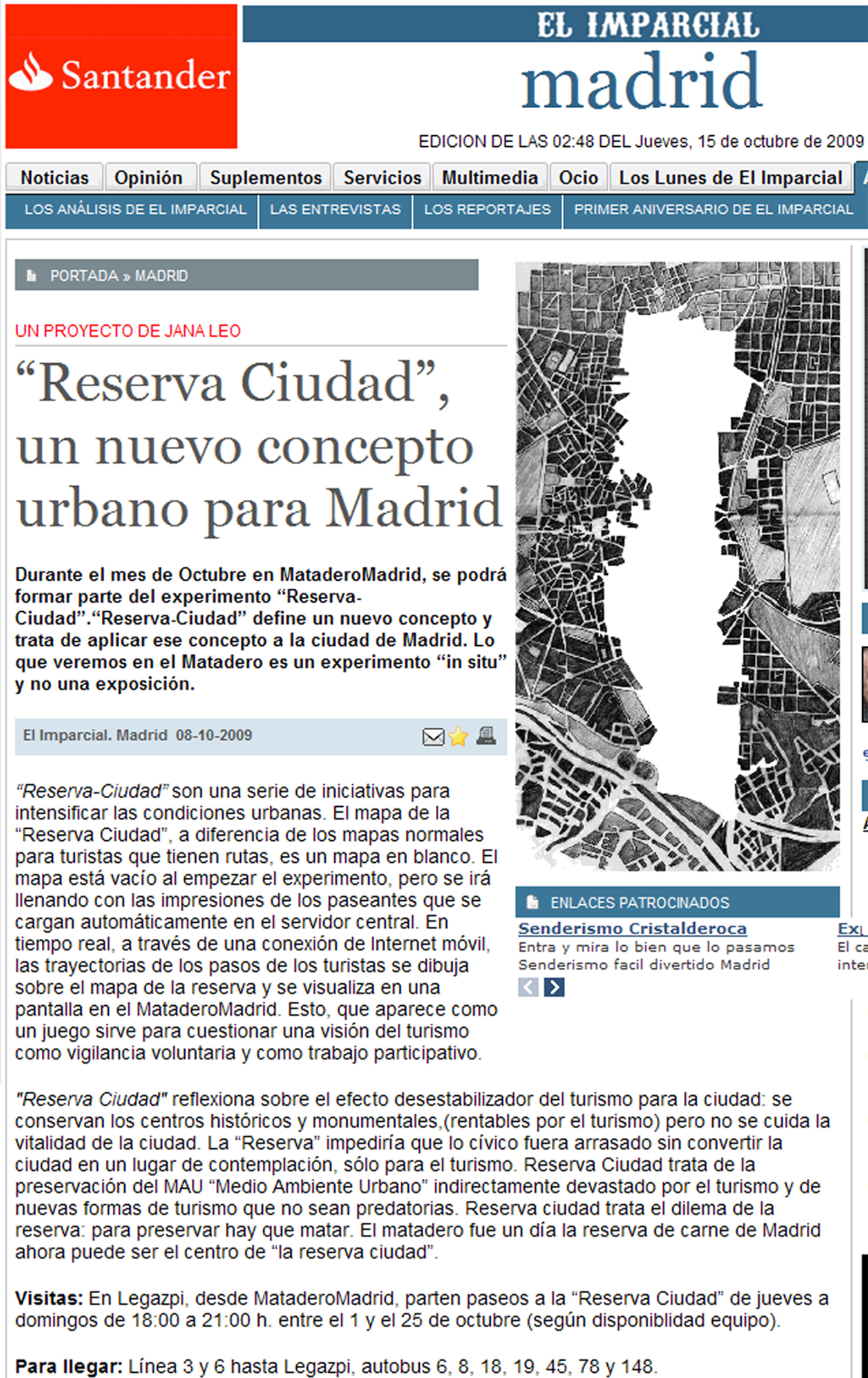
The map of the “City Reserve”, unlike regular tourist maps that feature routes, is a blank map. The map is empty at the start of the experiment, but it will gradually be filled with the impressions of the walkers, which are automatically uploaded to the central server. In real time, via a mobile Internet connection, the trajectories of the tourists’ steps are drawn on the reserve’s map and displayed on a screen at MataderoMadrid. This, which appears as a game, serves to question a vision of tourism as voluntary surveillance and as participatory labor.

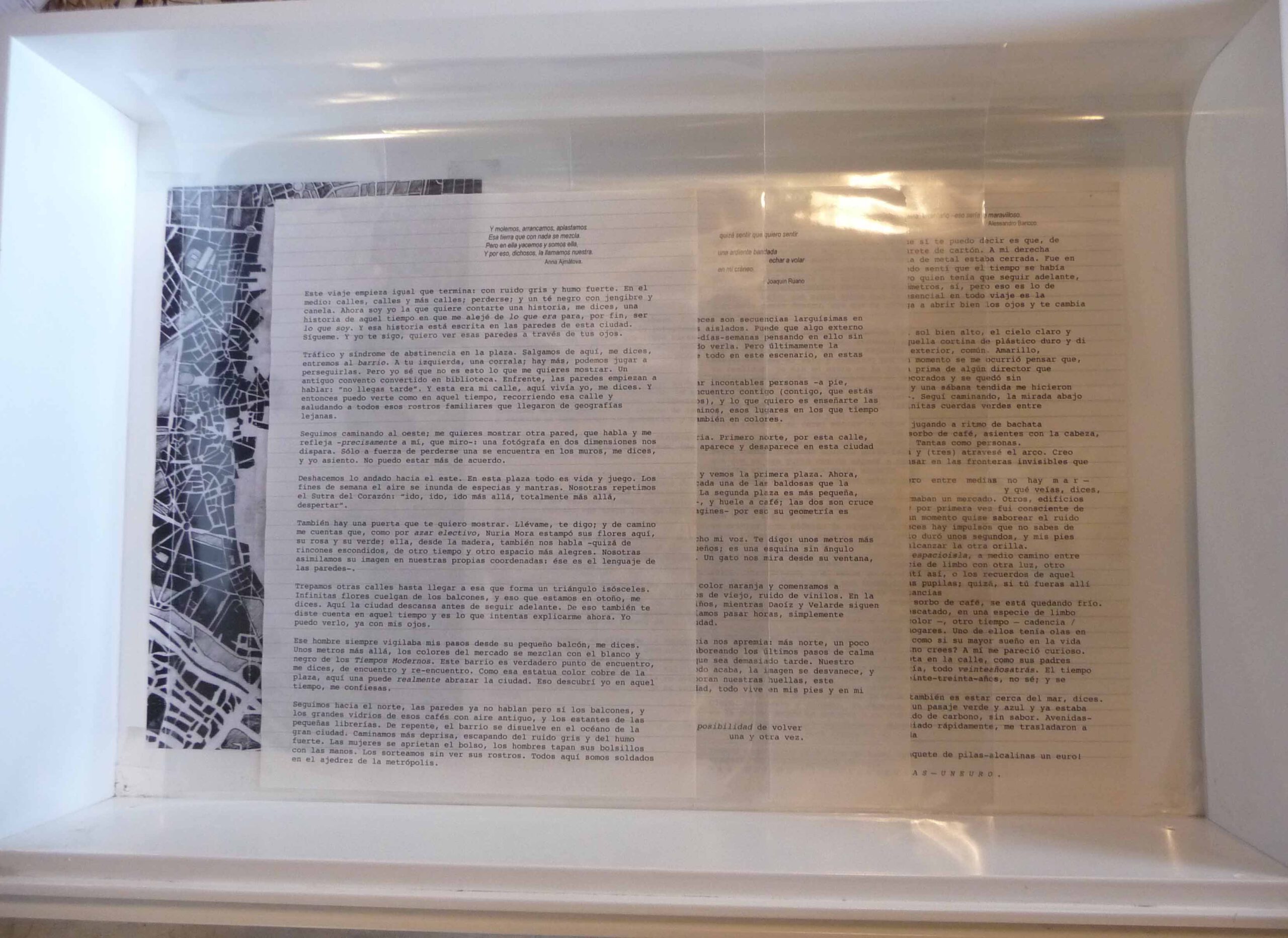
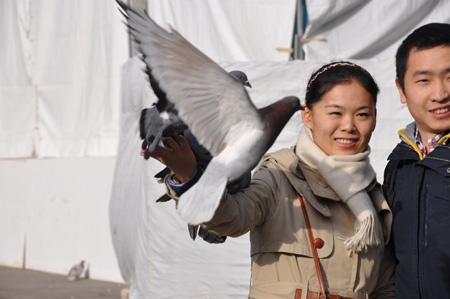
Two other situations, non-digital visits, shape the work. “I Will Be Your Eyes” is the title of the offering in which a photographer accompanies a tourist on a visit through the “City Reserve”. The tourist tells the photographer on the fly what they want to photograph; the difference between this and a regular tourist taking photos is that by having to translate what is to be photographed to another person, a conscious effort is made, and the photo is not taken automatically. On the other hand, through the photos, a frame is created for two strangers to come together: tourists and residents. “Walks with Letters” Three literary texts are provided to visitors and tourists. These are texts that can be taken along as companions on a stroll through the reserve, but they are rather stories, that is, something to enjoy while sitting and reading.

Information and Visit Bookings: From MataderoMadrid, in Legazpi, walks to the “City Reserve” depart from Thursday to Sunday, from 6:00 PM to 9:00 PM. Between October 1 and 25 (subject to equipment availability). To book, visit the Blog: http://reserva-ciudad.blogspot.com/. How to get there: Metro Lines 3 and 6 to Legazpi, bus 6, 8, 18, 19, 45, 78, and 148. From 4:00 PM to 10:00 PM.

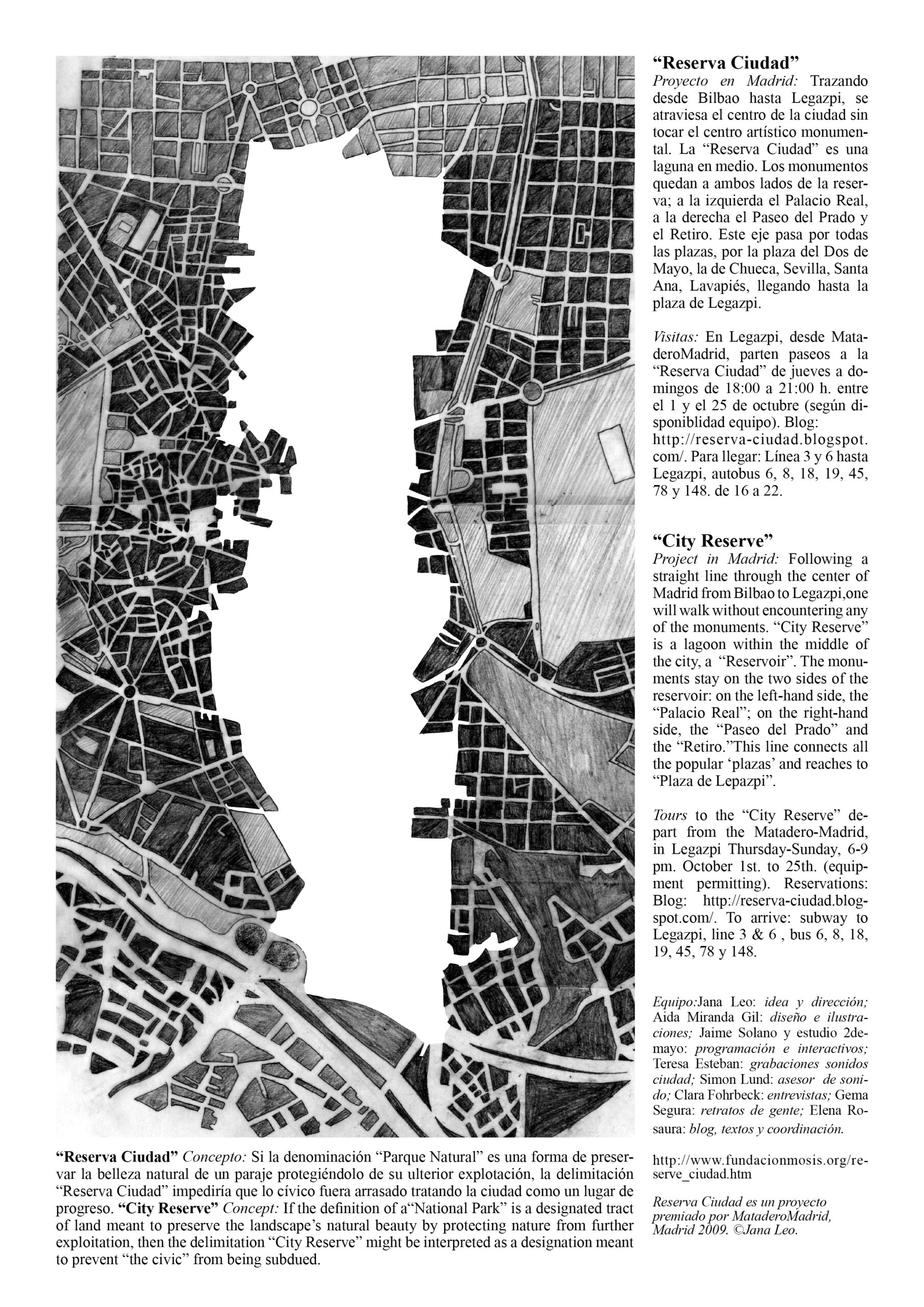
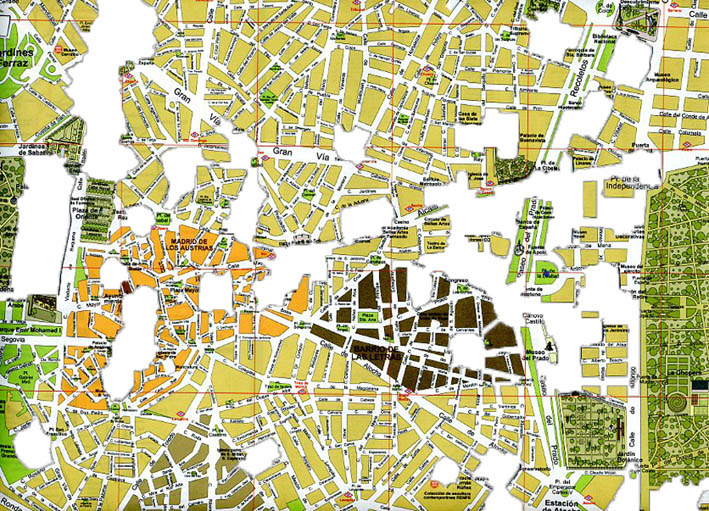
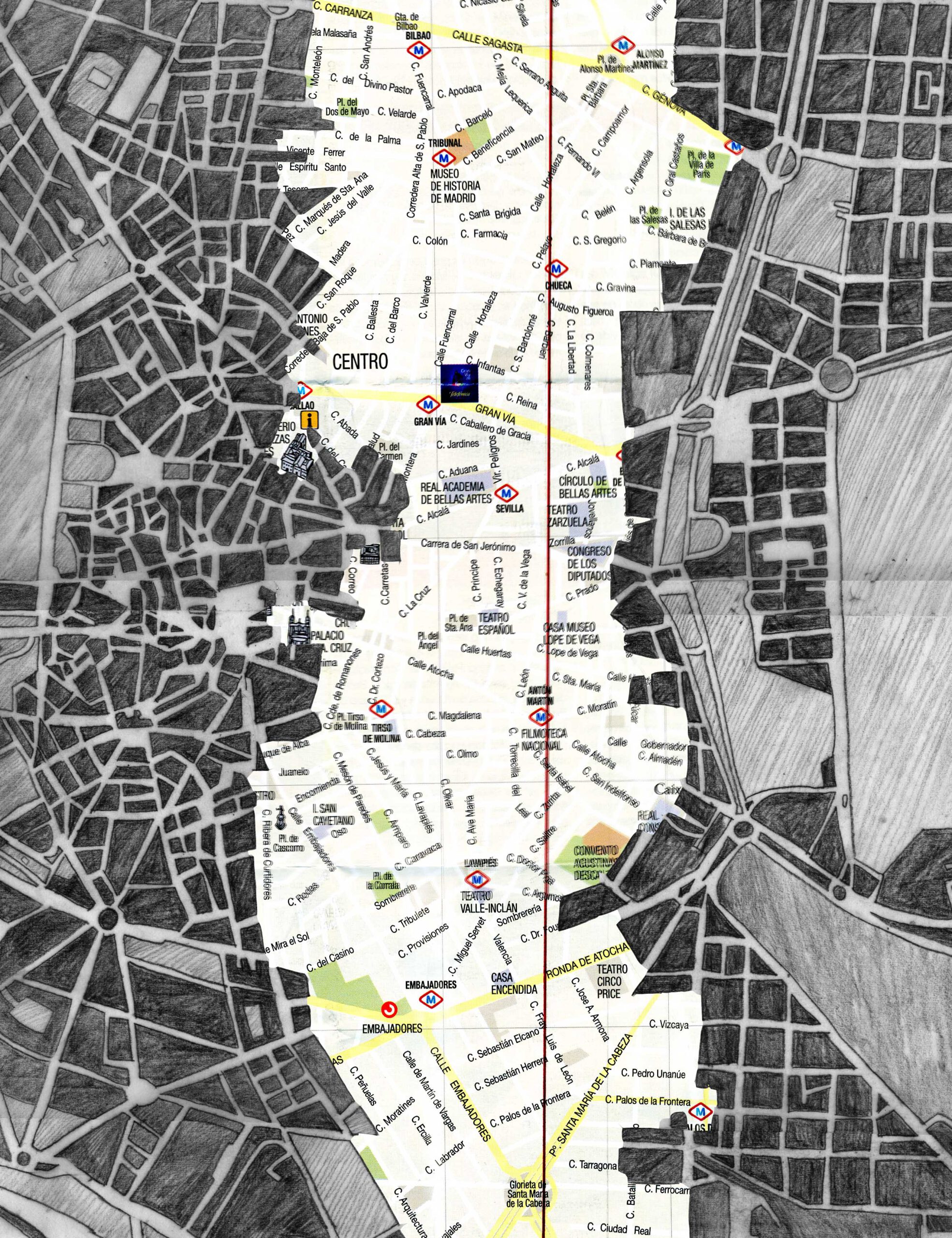
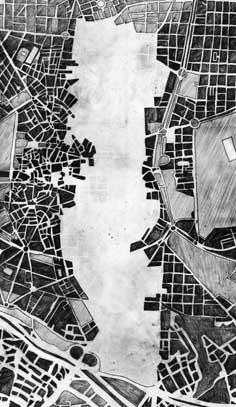
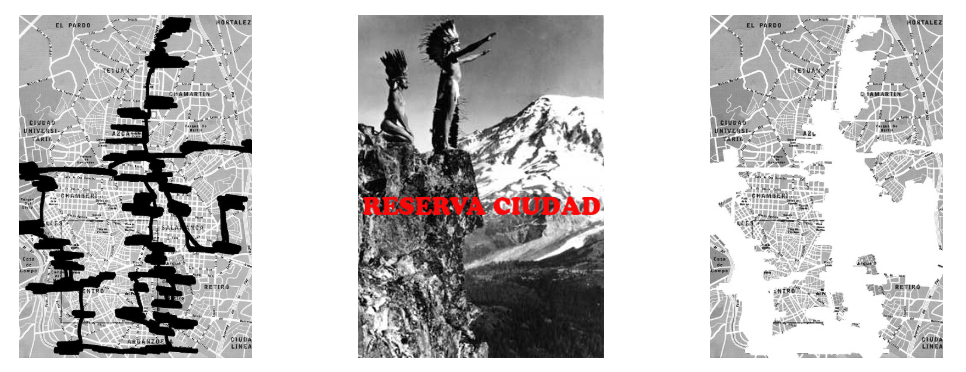
Example 1 “City-Reserve Madrid”. Drawing a straight line from Bilbao to Legazpi crosses the city center without touching the monumental artistic center. The city-reserve is a lagoon in the middle. A resident would walk through it. The monuments remain on both sides of the reserve, with the Royal Palace on the left, and the Paseo del Prado and El Retiro on the right. This axis passes through all the squares, through Plaza del Dos de Mayo, Chueca, Sevilla, Santa Ana, Lavapiés, reaching Plaza de Legazpi.

Visits to the City-Reserve: Thursday to Sunday from 6:00 PM to 9:00 PM, with prior registration at: reserva.ciudad@gmail.com

Project carried out in collaboration with Matadero, in 2009.

Production team: Jana Leo: idea and direction; Aida Miranda Gil: design and illustrations; Elena Rosauro: literary texts, blog, and coordination.

Clara Fohrbeck: fieldwork and interviews; Gema Segura: portraits of people; Teresa Esteban: sound recordings; Simon Lund: sound advisor; Empresa 2demayo: development of the interactive device, Jaime Solano in technical direction, Isidro Ruiz in programming, and Jaime Padilla in the interface.

Note: The walks operate from 6:00 PM to 9:00 PM, Thursday to Sunday. During the rest of Matadero Madrid’s public hours, visitors can view what has been generated throughout the experiment.

The artist Jana Leo sets up the conditions for the public to shape the piece, opposing the distinction between studio and gallery and challenging the paternalistic “participation” of the public in the artwork. When the staging (in public) begins, the experiment also begins, but until that moment, there is nothing to show. Based between New York and Madrid over the last ten years, Jana Leo has focused her attention on the city and especially on the predatory phenomena occurring within it. City Reserve follows the same lines of her immediately preceding work, Rape New York, but from the opposite end. Both works speak about the individual in the city, memories, and archives. Rape New York begins with an individual and shows the city in the background acting as a wide-angle lens. City Reserve begins with the city and zooms in on an individual whose steps are literally followed. Rape New York spoke of the perverse phenomenon in Manhattan: the displacement of crime to the interior of certain buildings, leaving others ready to be sold at high prices and leaving the street free for exploitation by tourism. City Reserve reflects on the destabilizing effect of tourism on the city: historic and monumental centers are preserved, but the UEN “Urban Environment” is neglected.

In reaction to the convulsive growth of statues and fountains in Madrid, Jana Leo worked ten years ago on a video game for the virtual destruction of statues in Madrid with Jaime Solano—who is also the collaborator in the technological development of the interactive device for tourists in City Reserve.

#foogallery-gallery-2359 .fg-image { width: 200px; }

The photographers of Madrid are: Borja Alvarez, Virginia de Diego, Noemi Larred, Jana Leo, Stephen Lucas, Simon Lund, Gabriella Moya, Juan Quesada, Lourdes Rey, and Mariana Treviño

Traducción realizada con la versión gratuita del traductor DeepL.comJacket for two:

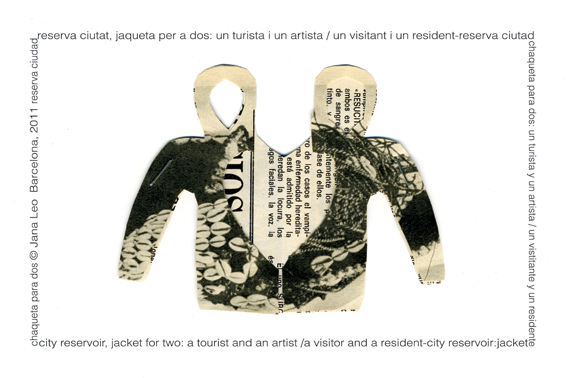
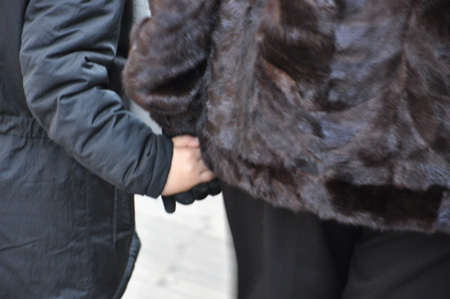
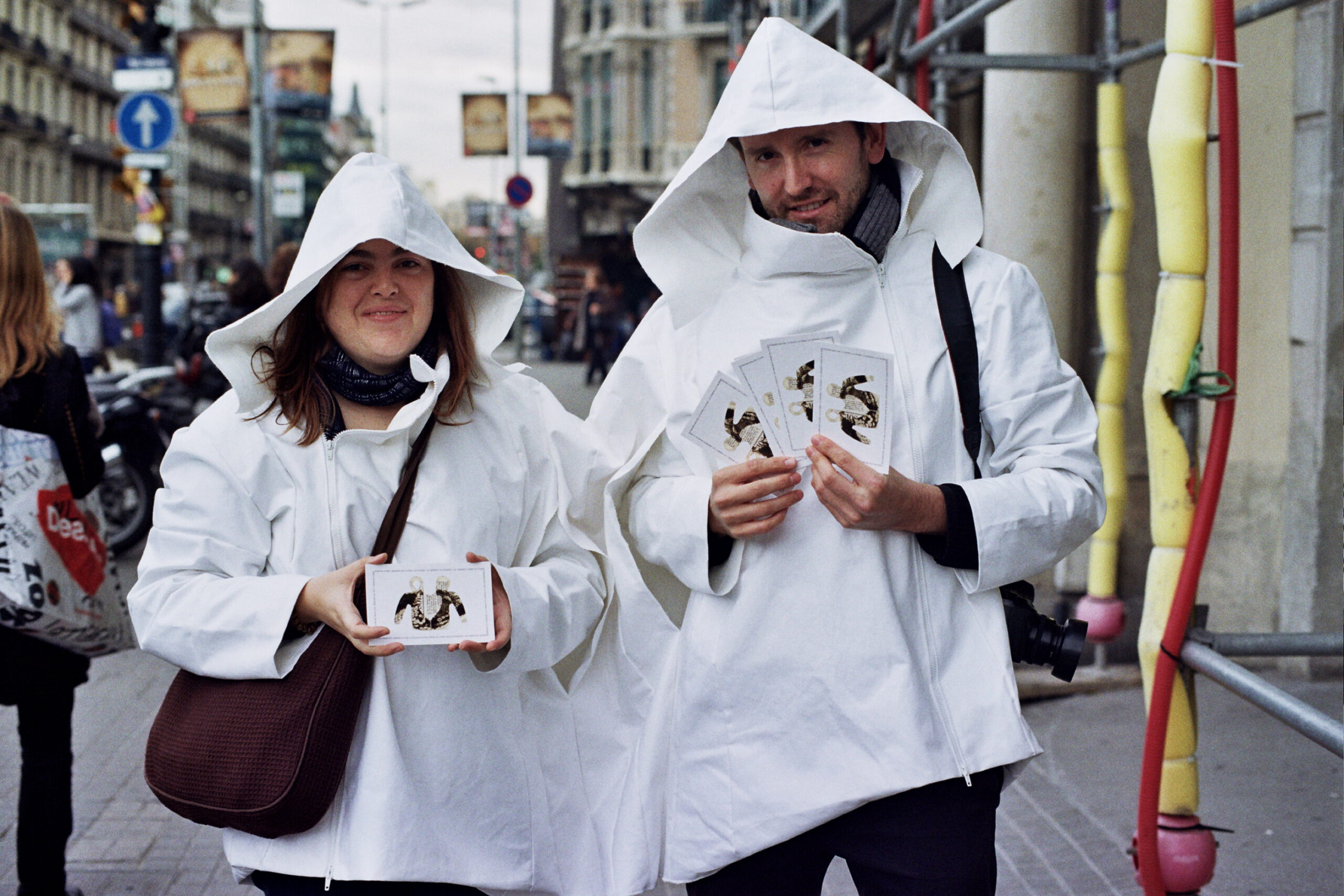
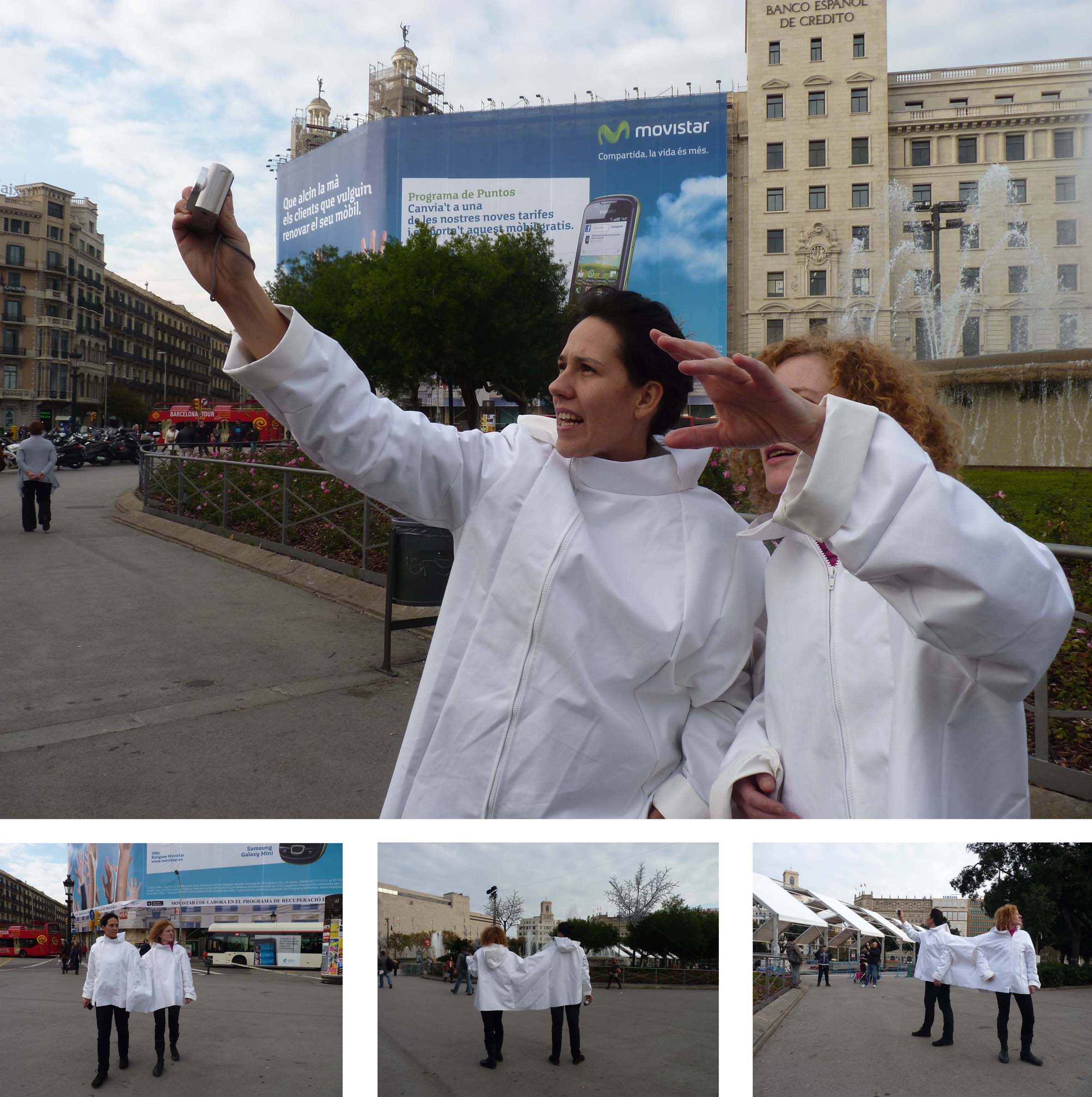
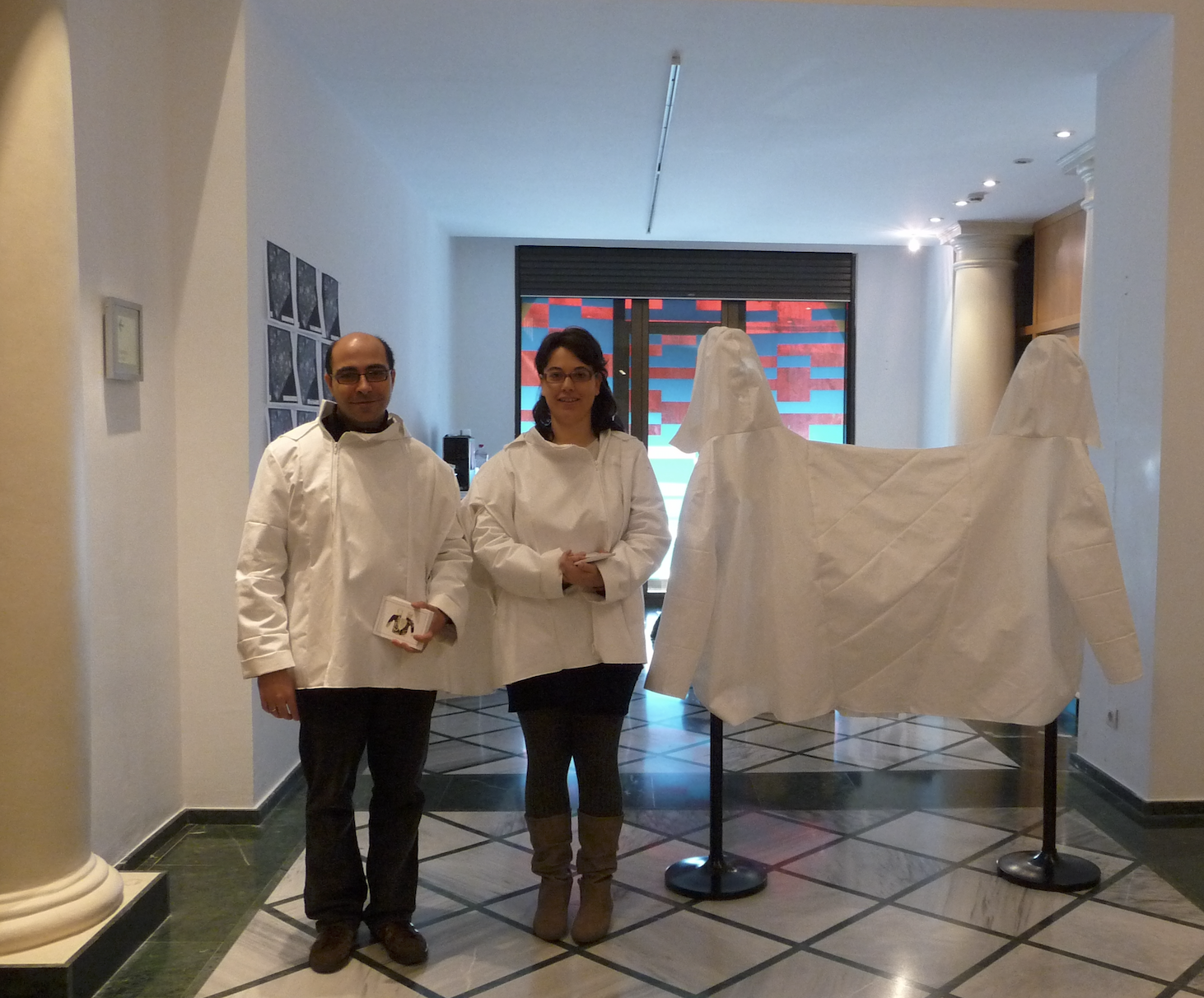
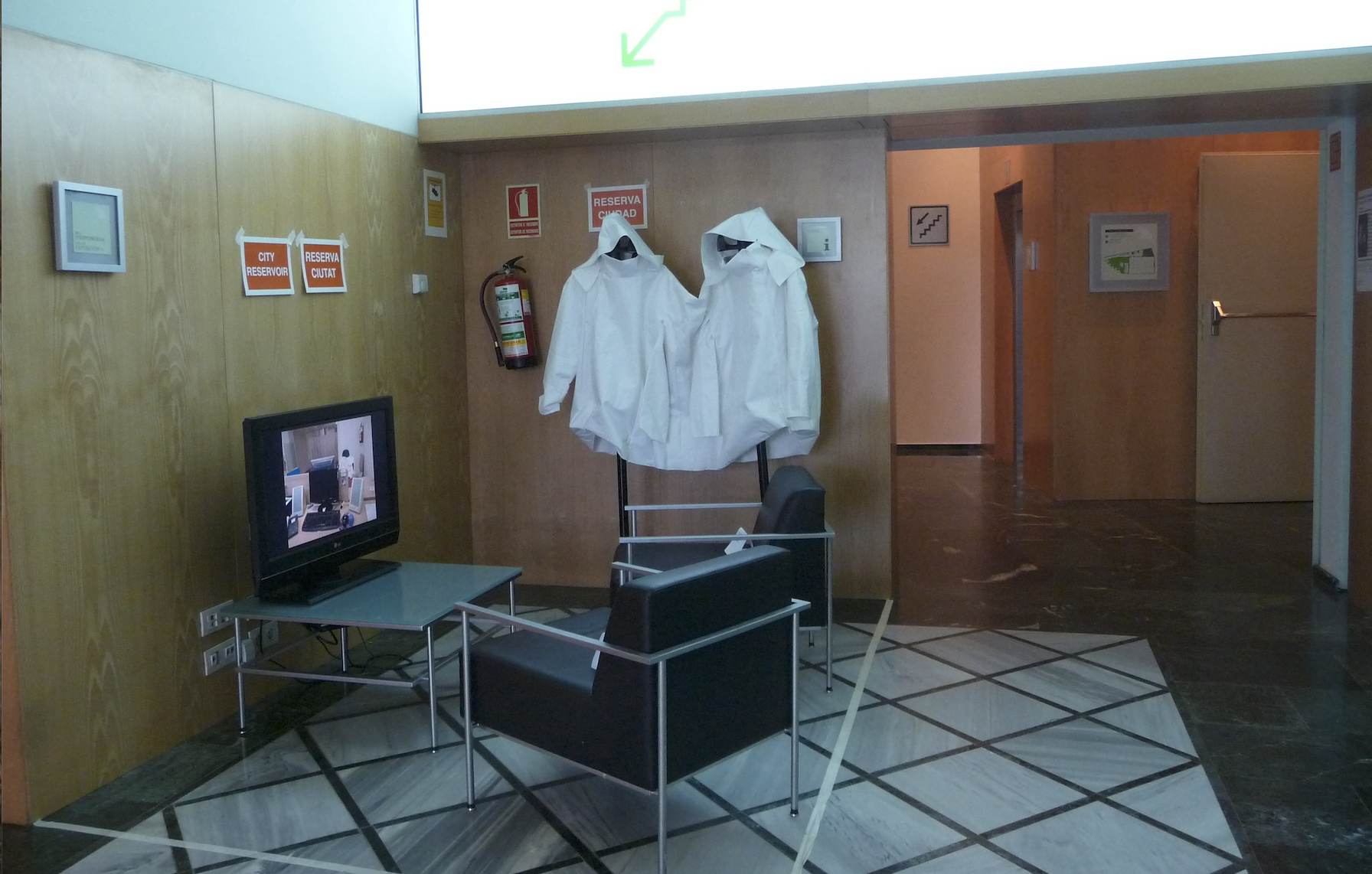
As a symbolic illustration of the walk and of the city reservoir, Barcelona, we designed: “jacket for two”. This “jacket for two” is a way to appropriate the city while visiting it (these two take space from the city for themselves). A little bit of science fiction and a little bit monastic: to put the jacket on is an entrance into another dimension. The jacket is a vehicle that one wears to change her/his mood. Primarily though, the jacket is intended to help facilitate an encounter between two unknown people in a city that is mainly known by one. The jacket serves as protection, not only from the weather but from judgment; when it is used for walking, it marks a bubble to walk in; used to publicize the project, it gives respect to the task of m postcards in the street. The white without logos or brand names contrasts with the highly charged advertising of city landscapes. “jacket for two” is an art piece, a form of publicity, and a manifesto about therelationship of one person with another and with the city.

Vehicles. Putting concepts into practice: tours

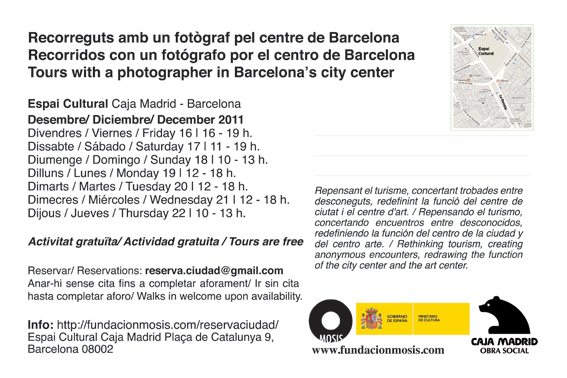
I Will Be Your Eyes. Tours with a photographer through the center of Barcelona
http://fundacionmosis.com/reservaciudad/

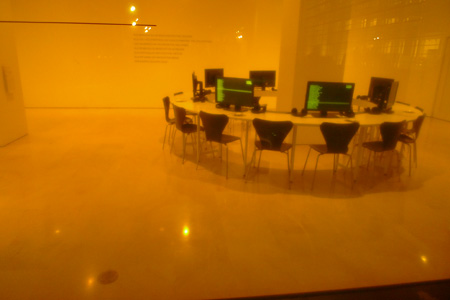
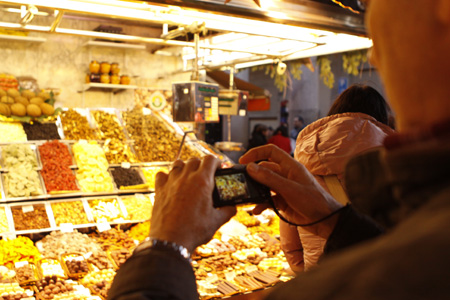
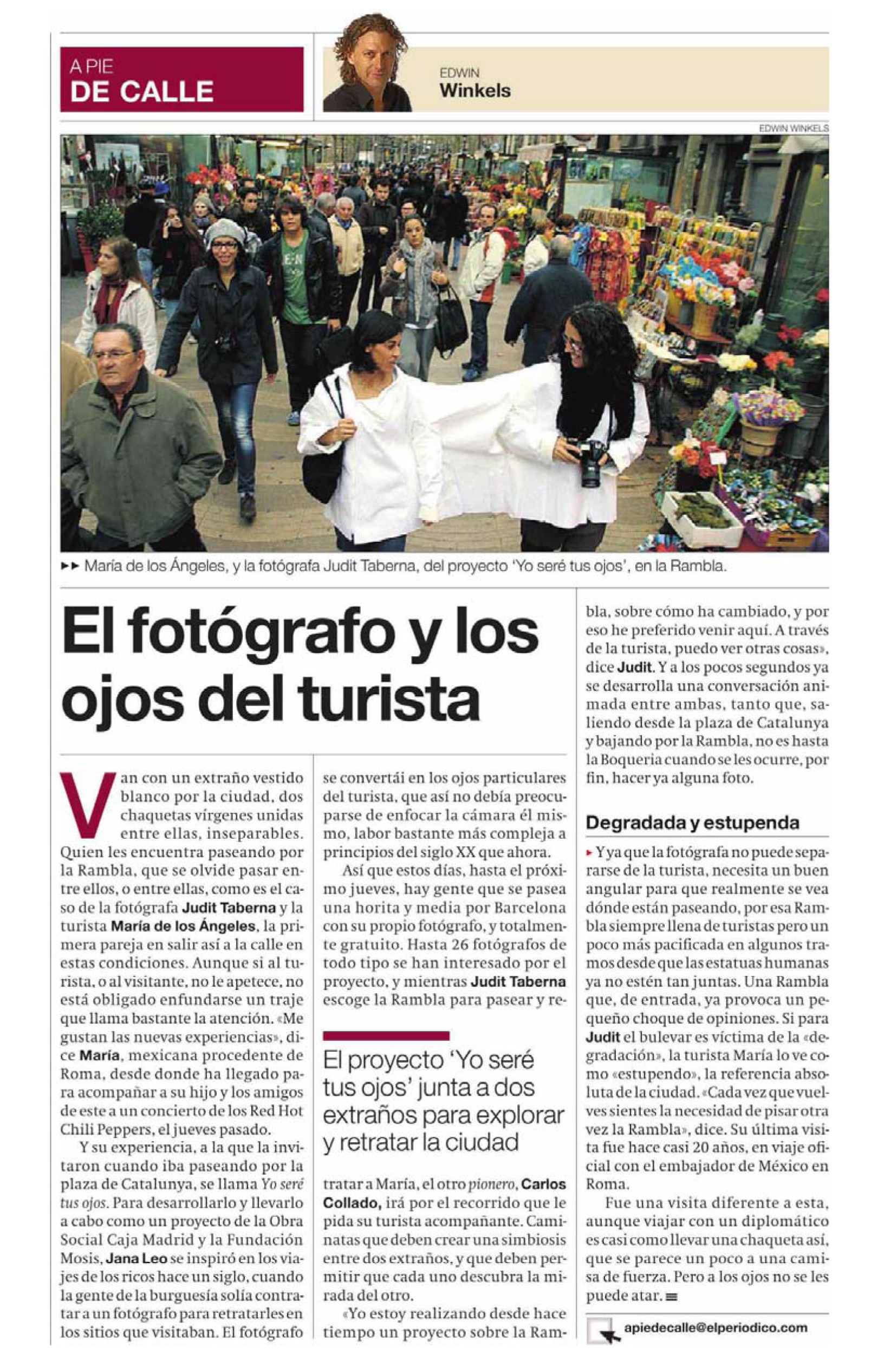
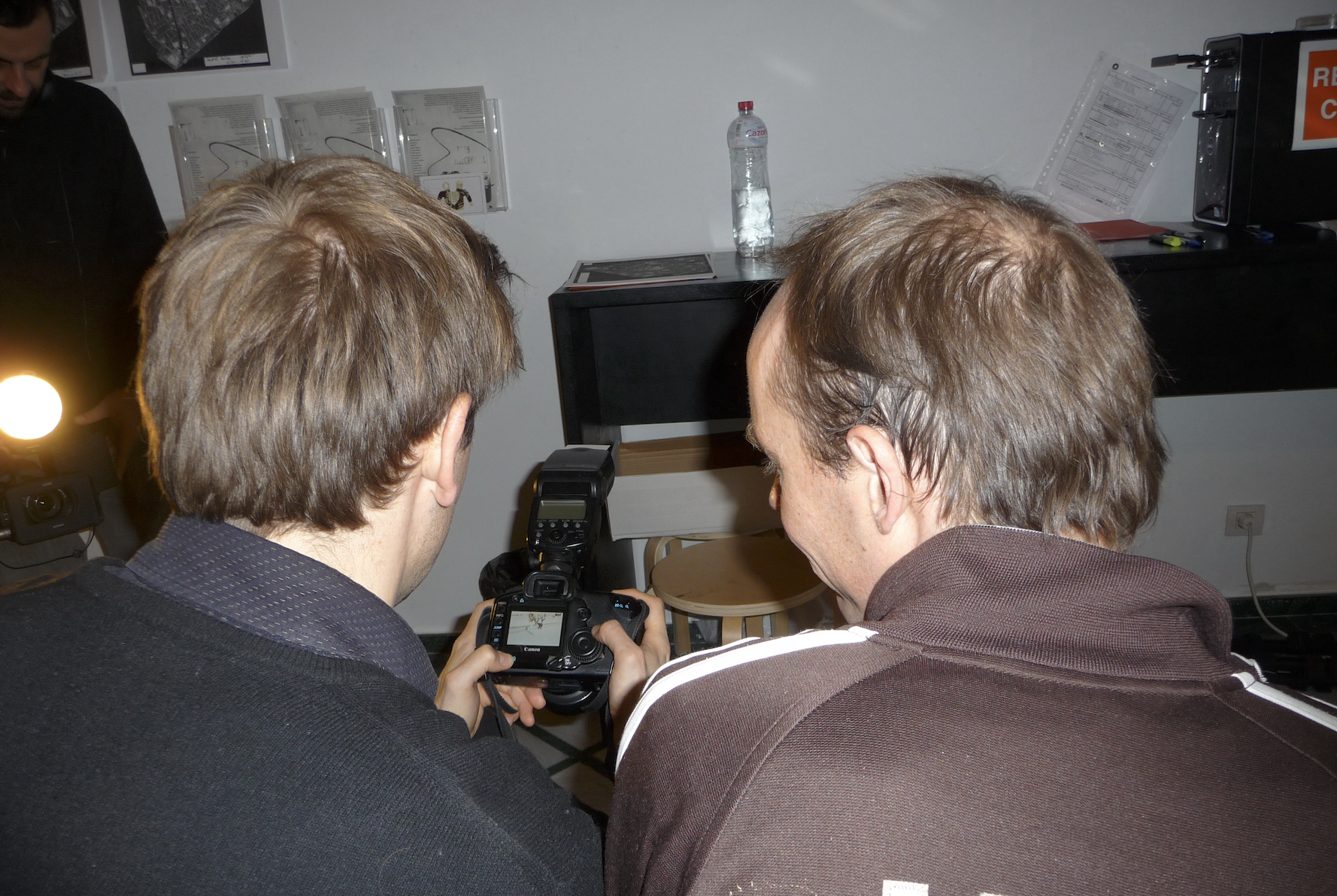
Departing from a cultural center, a photographer accompanies a tourist (a visitor or someone who wants to see the city through the eyes of another) on a tour through the city center. Once the walk is over, both return to the meeting point, where there is a computer to download the photos and burn a CD for the tourist, who takes home an “artist’s souvenir.” In the lobby of the cultural center, a “visitor reception center” has been installed where artists and tourists, resident photographers and visitors arrive, which also serves as the information point for the City Reserve project. The photos from the tours are uploaded and shown on a monitor as they are being taken, and they remain on display along with other objects from the experience for an additional three weeks. The photos are archived on a website similar to the one for the experience in Madrid.
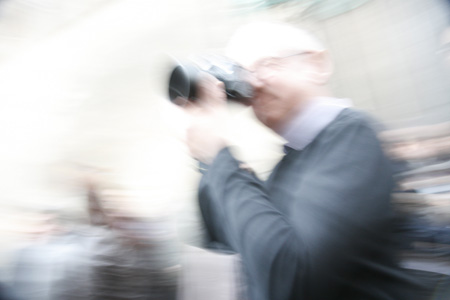
The process of searching for and selecting photographers is conceived as an indirect workshop where the myths and challenges of photography, as well as the importance of individual relationships, are discussed. The photographer will be the eyes of the tourist, taking photos following the tourist’s indications but questioning each image. Perhaps having to convey to another person what one wants to photograph implies a conscious effort, preventing them from blindly “sweeping” the city with the camera.

The meaning of the walks for tourists

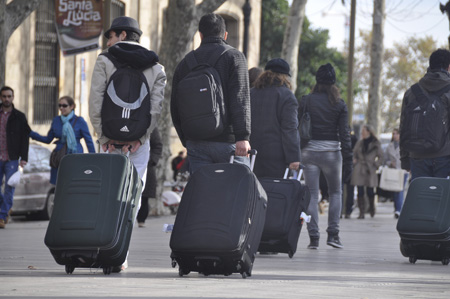
This “situation” gives rise to a relationship between two strangers: a photographer and a tourist who intimately share a city and some photos. Among all the things one remembers from a trip, personal relationships stand out. In this case, the souvenir is an artist’s souvenir. High-quality photographs traveling in the traveler’s suitcase or hard drive, which they will later show to their friends, spontaneously serve to promote the city and internationalize art; by showing these travel files, tourists disseminate the work of that photographer and globally export a culture. The photos and videos that tourists take with them are artist-authored reports made by artists who offer an intelligent and interesting image of the country the tourist is visiting. The tours between an artist and a tourist enhance human heritage (people) alongside monumental and urban heritage.

The meaning of the walk for residents.

A tour with a photographer is an aesthetic-political experience. Two people walk; someone has orchestrated their walk; they do not know each other; one of them carries a camera and taking photos is their job; the other has just arrived in the city, or lives there but is at leisure. They exchange jokes and then walk in silence, with the small interruptions of the shutter; the shots make them a witness: they are there, something is happening, it is real and they are seeing it. The one without a camera witnesses the city offered to them by the one taking photos. The camera begins to shift focus, and instead of photographing the one without a camera, who has already gained prominence, it centers on what is happening. The one taking photos and the one who isn’t, now accomplices, walk faster. …But witness to what? Accomplice to what? …Witness to human levity, to movement, to clear differences that yet lack a sense of being, to alienation in the streets of a city…. Accomplice to a barefoot city that has sold its skin to make crocodile shoes.”

As a symbolic illustration of the walk between two strangers on the occasion of City Reserve – Barcelona, a “Jacket for Two” has been designed. In a shared introspection, the jacket is a vehicle for a mental journey that tries to change the state of mind. Putting on the jacket is a gesture of entering another dimension.

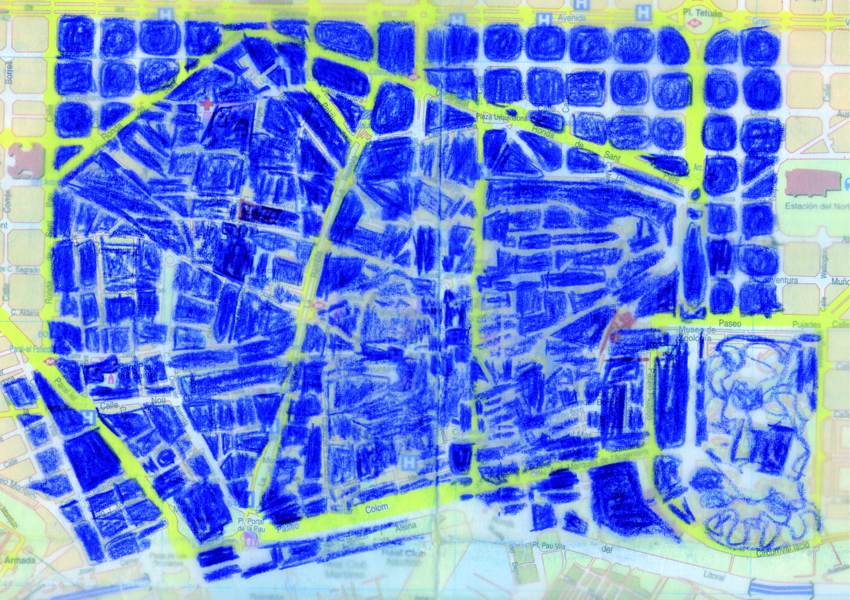
Mapping is a tool for reflection and generation. We treat the city as a work in progress. We start by drawing maps of the possible and potential cities in our city. We made maps of what is there (maps of the possible cities inside the city) and maps of what a city could be, (the different visions of a city). We cannot change city policies, but we can draw the one we envision. We set ourselves in the future, we act as if the change has already happen: the city is a place of excellence, where tourist and residents go to recreations and mental recharge. To imagine a new life is much harder than to wish for it.

We will visit the maps. Here the projected vision of the city encounters the real, showing the gaps and potentials. Visiting the maps is another step for the maps makers and a learning experience of the visitors, who will be educated in the translation of real and the envisioned. The visits are in the sense “detours”, because switch trajectories and drawing methods from what is expected.

Example 1. The city that a tourist walks versus the city that a resident walks.  “Madrid”. Project: “City Reservoir Madrid” 2009. Following a straight line through the center of Madrid from Bilbao to Legazpi, a tourist will continue on without encountering any of the traditional urban and cultural monuments. “City-Reservoir” is a lagoon within the middle of the city. The monuments stay on the two sides of the reservoir: on the left-hand side, the “Palacio Real”;on the right-hand side, the “Paseo del Prado” and the “Retiro.” This line connects all the popular ‘plazas’ within the area: “Plaza Dos de Mayo,” the “Plaza de Chueca,” “The Sevilla Plaza,” the “Plaza de Santa Ana,” “Plaza Lavapies,” and reaches to “Plaza de Lepazpi.” “Madrid Matadero” in Legazpi –once the ‘meatpacking’ district of Madrid, is now an art center.

En colaboración con Espai Cultural, Barcleona en Plaza de Cataluña.

RESERVA CIUDAD es un equivalente al “parque natural”, pero en centros urbanos o un equivalente al turismo rural en la ciudad, también turismo “cívico” que actúa a través de una serie de iniciativas que intensifican las condiciones urbanas, alientan el turismo cultural participativo, a la vez que  replantean el turismo de la ciudad, mientras los turistas la visitan.

En el proyecto presente, se diseñan visitas en la ciudad de Barcelona, un paseo físico y mental, a través de tres objetos culturales que los identifico como modulo1,2 y 3: 

” Entrevistas por Turistas” Un/a video-artista y un traductor/a salen a las calles cerca de Plaza de Cataluña y entrevistan a turistas sobre la ciudad. Les invitan a unirse al equipo, Así el turista, con la ayuda del traductor/a hace entrevistas a residentes de la zona. El/la video-artista graba, preguntándoles sobre que piensan de los turistas. Las entrevistas se editan en el Espacio Cultural, en video-clips de tres minutos Los videos se pondrían  en un monitor (formato loop) y estaría  visibles esa misma tarde. Así por las noches, los turistas y residentes que lo deseen pueden ir a verse en el centro.  Se realiza la acción una semana y se deja la documentación visible en la biblioteca del centro como un archivo cultural del barrio, un archivo cultural del barrio, visto por turistas. Se propone la segunda semana de Mayo 2011

Esta acción esta especialmente diseñada para el Espacio Cultural de Barcelona, pensando en el uso del léxico junto con la imagen de la ciudad y de las caras de las personas que participan así como de una primera puesta en marcha del proyecto “Reserva-ciudad” que no necesita de promoción pues el equipo al salir a la calle, saca a la calle el Espacio Cultural. Esta acción favorece la multi-culturalidad, da importancia a los participantes (les integra) al poner sus caras y educa a la vez que entretiene con imágenes variadas y selectas.

“Barcelona suena” Los residentes de la zona han de grabar los sonidos de sus casas o trabajos, creando un documento artístico de su vida diaria. Se ofrece una cámara de grabación junto un taller de apoyo para conseguir voluntarios de la grabación. El taller se da en la tercera semana de mayo y pero las grabaciones se podrán ir haciendo durante todo el verano. El centro, una vez entendido como lugar de trabajo de la ciudad, acogerá a interesados que con suerte querrán participar en el proyecto. En octubre, se recogen los resultados y al momento se editan los sonidos. De esta forma se hace un archivo de sonidos de una Barcelona de andar por casa.

“Yo seré tus ojos” Un fotógrafo acompaña a un turista o visitante en un paseo por la “Reserva Ciudad”, alrededor del Espacio Cultural de Barcelona. El turista le dice al fotógrafo sobre la marcha lo que quiere fotografiar. El acto de fotografiar se divide en dos partes: una, es la mente y la imagen deseada del turista y dos, los ojos, las manos, la cámara y el fotógrafo.

El fotógrafo usando una cámara digital, intenta traducir las instrucciones del turista en imagenes. Quizá el tener que trasmitir al otro lo que se quiere fotografiar, supone un esfuerzo consciente, evitando “barrer” la ciudad con la cámara. Por otro lado es el hecho y escenario perfecto, para que dos desconocidos en dos categorías: turista y residente, se relacionen con cierta intensidad.


VER ARCHIVO COMPLETO

“YO SERE TUS OJOS”. Recordando la costumbre que se tenía a principios del siglo XX entre los ricos de viajar con un fotógrafo que tomara fotos por él, en “Yo seré tus ojos” un fotógrafo acompaña a un turista o visitante a un paseo por la “Reserva Ciudad” (centro de las ciudades, principalmente zona comercial, en el que no hay lugar para la reflexión ni el encuentro con el otro). Una vez acabado el paseo, ambos vuelven al lugar de encuentro donde hay un ordenador en el que se descargan las fotos y se graban en un CD para el visitante que se lleva un “souvenir de autor”. En “Yo seré tus ojos”, el turista le dice al fotógrafo lo que quiere fotografiar. El fotógrafo intenta plasmar la petición del turista en imagen. El acto de fotografiar se divide en dos: uno, la mente, la imagen deseada, el turista; y dos, los ojos, las manos, la cámara, el fotógrafo. Al tenerle que traducir al otro lo que se quiere fotografiar se hace un esfuerzo consciente y la foto no se hace en automático, evitando “barrer” la ciudad con la cámara. El Espai Cultural Caja Madrid-Barcelona y Matadero-Madrid han albergado el proyecto. Acción realizada con la ayuda del Ministerio de Cultura de España. Este “tour” se probó por primera vez en octubre de 2009 gracias a una ayuda de Matadero-Madrid para el proyecto colectivo de Jana Leo “Reserva-Ciudad”.

Los fotógrafos de Barcelona son: Abel Pau Garcia, Aizea Arce, Albert Pi, Andrés Gálvez, Carlos Collado, David Querol, Enric Sirera, Finchy Patrick, Garbiñe irizar, Judit Taberna, Konstantina Gavala, Manuel Serra, Monica Busquetsm Nardi Bayarri, Regina Barbas, Richard Vanderaa, Santos MontesXavier Roldan, Ramon Vilalta.

“I WILL BE YOUR EYES” A photographer goes with a tourist or visitor and takes pictures of what the tourist requests. The act of photographing is broken into two: the mind (the tourist); the eyes, and the hand, the machine (the photographer). The photographer needs to make an image that fits the tourist desire but also that questions the practice of a tourist taking pictures like firing a machine gun. The photographer, often using a digital camera, might shoot many versions of the same image following instructions from the tourist. Once the tour is finished the visitor take home and “autor souvenir” a CD with the pictures freshly taken. This “tour” is a remembrance of the custom among the rich to travel with a photographer who would take pictures for you. The walks create a context in which two strangers and two categories: tourist and resident relate to each other intensively. The Espai Cultural Caja Madrid-Barcelona and Matadero-Madrid had hosted of project. Activity made with the help of the Minsistry of Culture of Spain. This “tour” was tested for the first time in October 2009 thank to a grant by Matadero-Madrid to Jana Leo’s collectie Project “Reserva-Ciudad”.

“JO SERÉ ELS TEUS ULLS”. Recordant el costum que es tenia a principis del segle XX entre els rics de viatjar amb un fotògraf que prengués fotos per ells, a “Jo seré els teus ulls” un fotògraf acompanya a un turista o visitant a fer un passeig per la “Reserva Ciutat” (centre de les ciutats, principalment zona comercial, on no hi ha lloc per a la reflexió ni l’encontre amb l’altre). Un cop acabat el passeig, tots dos tornen al lloc d’encontre on hi ha un ordinador en què descarreguen les fotografies, que es graven en un CD per al visitant que s’emporta un “souvenir d’autor”. A “Jo seré els teus ulls”, el turista li diu al fotògraf el que vol fotografiar. El fotògraf intenta plasmar la petició del turista en imatge. L’acte de fotografiar es divideix en dos: un, la ment, la imatge desitjada, el turista; i dos, els ulls, les mans, la càmera, el fotògraf. A l’haver de traduir a l’altre el que es vol fotografiar, es fa un esforç conscient i la foto no es fa automàticament, evitant així “escombrar” la ciutat amb la càmera. L’Espai Cultural Caja Madrid-Barcelona e Matadero-Madrid alberga el projecte. Acció realitzada amb l’ajuda del Ministeri de Cultura o Espanta. Aquest “tour” es va fer per primera vegada l’octubre de 2009 gràcies a un ajut d’Escorxador-Madrid per al projecte col • lectiu de Jana Leo “Reserva-Ciutat”.
Como ilustración simbólica del paseo y del embalse de la ciudad, Barcelona, diseñamos: «chaqueta para dos». Esta «chaqueta para dos» es una forma de apropiarse de la ciudad mientras se visita (estos dos se adueñan de un espacio de la ciudad para ellos solos). Un poco de ciencia ficción y un poco de monacato: ponerse la chaqueta es como adentrarse en otra dimensión. La chaqueta es un vehículo que uno se pone para cambiar de estado de ánimo. Sin embargo, su principal objetivo es facilitar el encuentro entre dos desconocidos en una ciudad que uno de ellos conoce bien. La chaqueta sirve de protección, no solo contra el clima, sino también contra el juicio ajeno; cuando se usa para pasear, marca una burbuja en la que caminar; cuando se usa para dar a conocer el proyecto, confiere dignidad a la tarea de repartir postales en la calle. El blanco, sin logotipos ni marcas, contrasta con la publicidad tan intensa de los paisajes urbanos. «Jacket for two» es una obra de arte, una forma de publicidad y un manifiesto sobre la relación de una persona con otra y con la ciudad.
«Jacket for two»

Idea: Jana Leo ©

Realización: Jimena González

http://fundacionmosis.org/reservaciudad/

Vehículos. Llevando los conceptos a la practica: tours

Yo Seré Tus Ojos. Recorridos con un fotógrafo por el centro de Barcelona

Partiendo de un centro cultural, un fotógrafo acompaña a un turista (visitante o alguien que quiere ver la ciudad a través de los ojos de otro) en un recorrido por el centro de la ciudad. Una vez acabado el paseo, ambos vuelven al lugar de encuentro, donde hay un ordenador en el que se descargan las fotos y se graba un CD para el turista que se lleva un “souvenir de autor” . En el hall del centro cultural se ha instalado un “ centro de recepción visitantes” al que llegan los artistas y turistas; fotógrafos residentes y visitantes que es también el punto de información del proyecto reserva ciudad. Las fotos de los recorridos se van cargando y mostrando en un monitor a la vez que se van haciendo y se dejan en exposición junto con otros objetos de la experiencia tres semanas más. Las fotos se archivan en una página Web como la de la experiencia en Madrid
El proceso de búsqueda y selección de fotógrafos se concibe como un taller indirecto donde se habla sobre los mitos y los retos de la fotografía y la importancia de la relación individual. El fotógrafo será los ojos del turista que toma fotos siguiendo las indicaciones del turista pero cuestionando cada imagen. Quizá el tener que trasmitir al otro lo que se quiere fotografiar, supone un esfuerzo consciente, evitando “barrer” la ciudad con la cámara.

El sentido de los paseos para los turistas

Esta “situación” da pie a una relación entre dos desconocidos: un fotógrafo y un turista que comparten de forma íntima una ciudad y unas fotos. De entre todas las cosas que uno recuerda de un viaje son las relaciones personales. En este caso el souvenir, es un souvenir de autor. Las fotográficas que viajando en alta calidad en la maleta o en el disco duro del viajero que luego enseñará a sus amigos sirven de forma espontánea de difusión de la ciudad y de internacionalización del arte; los turistas al enseñar estos archivos de viaje difunden el trabajo de ese fotógrafo y a nivel global exportan una cultura. Las fotos y videos que los turistas se llevan son reportajes de autor hechos por artistas que ofrecen una imagen del país que el turista visita inteligente e interesante. Los recorridos entre un artista y un turista potencian el patrimonio humano (las personas) junto al monumental y urbano.

El sentido del paseo para los residentes.

Un recorrido con un fotógrafo es una experiencia estético-política. Dos personas pasean; alguien ha orquestado su paseo; no se conocen; una de ellas lleva una cámara y tomar fotos es su trabajo; la otra acaba de llegar a la ciudad, o vive en ella pero está ociosa. Intercambian bromas y luego caminan en silencio con las pequeñas interrupciones del disparador; los disparos le hacen testigo: está allí, algo pasa, es real y lo está viendo. El que no lleva cámara presencia la ciudad que el que hace fotos le ofrece. La cámara empieza a desviarse y en lugar de fotografiar al que no lleva cámara, que ya ha tomado peso, se centra en lo que está pasando. El que hace fotos y el que no, cómplices ahora, pasean más rápido. …Pero testigo de qué? Cómplice con que? …Testigo de la levedad humana, del movimiento, de las diferencias claras pero sin sentido de ser, de la alienación en las calles de una ciudad…. Cómplice con una ciudad descalza que ha vendido su piel para hacer zapatos de cocodrilo.”

A modo de ilustración simbólica del paseo entre dos desconocidos con la ocasión de Reserva ciudad –Barcelona, se ha diseñado una “Chaqueta para dos”. En una introspección compartida, la chaqueta es un vehículo de un viaje mental que trata de cambiar el estado de ánimo. Ponerse la chaqueta es un gesto de entrar en otra dimensión.

Mapping is a tool for reflection and generation. We treat the city as a work in progress. We start by drawing maps of the possible and potential cities in our city. We made maps of what is there (maps of the possible cities inside the city) and maps of what a city could be, (the different visions of a city). We cannot change city policies, but we can draw the one we envision. We set ourselves in the future, we act as if the change has already happen: the city is a place of excellence, where tourist and residents go to recreations and mental recharge. To imagine a new life is much harder than to wish for it.

We will visit the maps. Here the projected vision of the city encounters the real, showing the gaps and potentials. Visiting the maps is another step for the maps makers and a learning experience of the visitors, who will be educated in the translation of real and the envisioned. The visits are in the sense “detours”, because switch trajectories and drawing methods from what is expected.

Reserva Ciudad