VISIT-ARTE: guided tours through art in relation to an event that took place in a specific location in the city of Madrid using the Art-rededor App
Description
Visitarte are guided visits, walks, or tours focusing on public art or art that originates from an event that occurred in a specific neighborhood or district. These visits serve as a platform to raise awareness through art about a social issue in ordinary life, and as a way to cultivate an appreciation for art among those who have not yet understood its purpose. As a tool, we use Artrededor, the app we created featuring art centered on gender-based violence in the Comunidad de Madrid. https://artrededor.fundacionmosis.com/
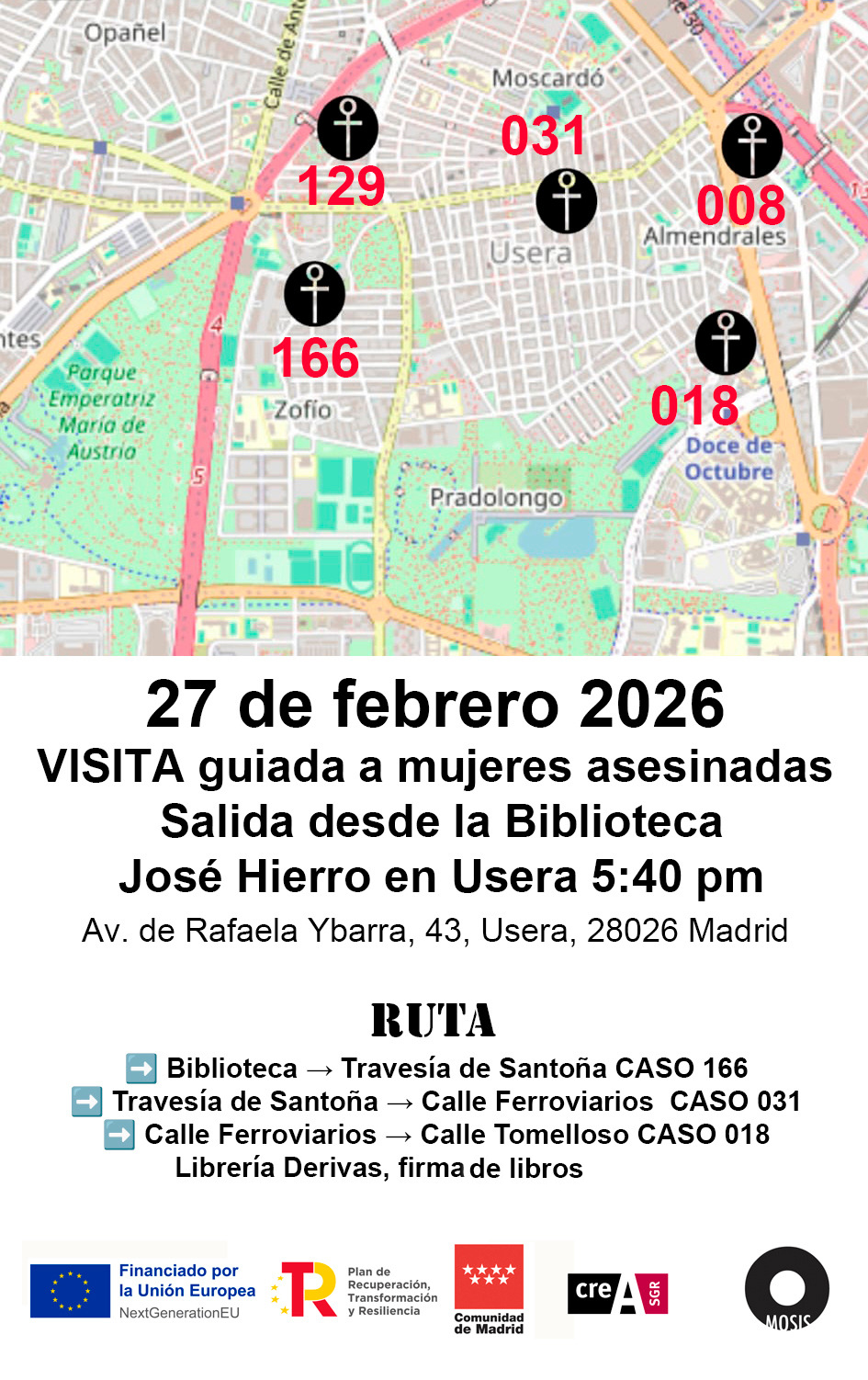
This is a package of guided tours to the locations in the Comunidad de Madrid where women were murdered by their partners between 1999 and 2024, sharing the story of each victim at the very site where she was killed. Due to current legislation, a large part of the information in our database regarding each murdered woman has not been made public, neither in the book nor in the app. The tour is the moment when all relevant information is shared orally to understand all the elements of gender-based violence. The murders of women by their partners are not considered historical memory, meaning that publicizing them is highly restricted, yet their lives risk being forgotten. Taking part in this walk means keeping alive the history of the women who lost theirs.
Schedule: Contact mosis to check scheduling at info@fundacionmosis.com
How it works: The starting point of the tour, or the “visitor reception center,” is the cultural center that serves as the meeting point. The approximate sequence of a guided tour is as follows: Participants arrive at the “visitor reception center” from the neighborhood itself or from others, followed by a 10-minute presentation. The designed walking route then begins, which includes a visit dedicated to the murdered women; participants walk around the block reading the account of the deceased woman as a ritual of remembrance and accompaniment of that person when she was alive. A drawing created in relation to that death is displayed. Each participant can follow along on their mobile phone using the Fundacion Mosis Artrededor app. The guide shares part of the story and details that are not available on the app.
Objectives
- To visibility art projects oriented towards civic engagement that feature a participatory localization component in public spaces.
- To raise awareness about various social issues through art. To create a non-invasive model of art that integrates into our lives in a humble and modest way, shifting the mindset to foster reflection, elevating daily existence, and keeping social memory alive through works of art.
- To contribute to education for the prevention and eradication of violence (gender-based, institutional, etc.) by remembering that this violence exists. To bring to light the murders of 166 women at the hands of their husbands, partners, or ex-partners in the Comunidad de Madrid between 1999 and 2024 through our VIDAS archive, which compiles the circumstances of these cases to collaborate in gender-based violence prevention education.
- To stimulate the creation of more site-specific art (“lugarización”) and memory art. There are very few artworks centered around an event that occurred in a specific location (“lugarización”), and even fewer located in the streets or other public spaces. The reasons are that this type of art is highly expensive. Firstly, because it requires extensive research (creating an archive, building a database, collecting data, cross-referencing information, and then translating it visually). Secondly, because not much art can withstand outdoor exposure, and there is a heavy bureaucratic burden for its installation. Our project addresses this vacuum in both its creation and dissemination.
- To value the daily life of the city over the monumental city. A city is visited as a way to understand its culture, its history, and above all, its spirit. This manifests in monuments (for example, the Plaza del Dos de Mayo, which commemorates the liberation from the French with its statue) and in museums that house art reflecting the sensibility of an era. However, a city is also its people and its history—that of its residents. Yet, these aspects are rarely visitable, and there are no guides about them. Ana María Guasch speaks of the artwork “as an archive.” The artist recovers memory by creating art about past events, and the visitor revisits that memory by viewing the work.
Visitarte has two meanings (being an “art visit” and, on the other hand, “visiting you”)
- Being an art visit, it is an exhibition, but not in a museum! Out in the street. Civic and public art is visited within the city’s neighborhoods. Normally you go to the museum, but with Visitarte the art comes to you; you do not move, you rediscover. Visitarte comes to you, shows you what you might not have known, and lets you explore and experience your neighborhood through art—art that references your own neighborhood.
- Visitarte means visiting you. Visiting someone who was forgotten. Frequently, art in public spaces refers to something that happened there, perhaps to a person. Their memory is visited, which is like “paying a visit” to the person and accompanying them. Examples include the memory bricks by Gunter Demnig about Spaniards who lost their lives to Nazism, remembered by bricks on the sidewalks where they used to live. Or the women murdered by their partners within a specific timeframe (1999-2024) in a specific location (the Comunidad de Madrid project by Jana Leo, archived by our Mosis foundation).
The art of site-specificity (“lugarización”)
Visits are paid to art whose origin stems from an event that occurred in a specific place, that has affected individuals, and that speaks to daily life experiences. This art can be termed archive art, context-art, or site-specific art (“arte de lugarización”); it is everyday art that helps document and remember past events, carrying a social, anthropological, and/or memory-based content.
Positive Impacts
- We bring art into life. Visitarte can change the perception that culture is something exclusive to the city center. We bring art to the person, in their neighborhood, in the form of a tour; we integrate art into life as a way to feel better, to remember, and to reflect, and we conceive the city as a large art gallery—a massive exhibition filled with art through an atmosphere of micro-events (tours) in non-central locations. The idea of bringing art to the citizen instead of the citizen traveling to the art (to the museum, to the center) is a step toward revaluing the periphery.
- We will provide an indirect platform for connection and socialization. Unlike the usual model of the Cultural Industries that simply offer an activity, we provide a channel of connection to events and reality, but through the intangible, memory, and art.
Commitment to continuity
Once the project is completed, we hand over the design of our tours and the documentation to local associations, boards, and centers so they can continue running them with neighborhood guides. We will also incorporate the localized art we discover into our app, allowing users to independently take their own tours.
Proposed methodology for project development
Our approach is tangential—addressing one matter through another:
- The walk provides a framework to discuss art and violence, view art, and actively receive information about art and memory. For many women and men, going for a walk feels more familiar than enrolling in a course, which is why the activity is designed as guided tours—an exhibition in the museum of the streets.
- To bridge the gender gap and increase male participation, the strategy also includes showcasing public art in the area, not just this project, as a way to attract men to the activities and educate them on the prevention of gender-based violence.
- The tours are supported by an app, making them appealing to a younger audience.
- By default, our visits stimulate neighborhood and social interactions between long-term residents and newcomers. This is particularly interesting in neighborhoods where lifelong residents barely interact with new neighbors.
Target
It is aimed at anyone who wants to gain a deep understanding of other Madrid neighborhoods beneath the surface; anyone from a local neighborhood or the city center who is curious about memory, but who may at times lack artistic training or awareness regarding art.
What is included
Budget
The price adapts to each situation. Up until now, while the prototype was being launched, it has been free of charge.
In the future, for the general public, the base package of 2 tours for up to 25 people will cost 1,000 Euros for the Cultural Center, which covers the use of the app, the design of the route, the concept, and the tour guiding services.