

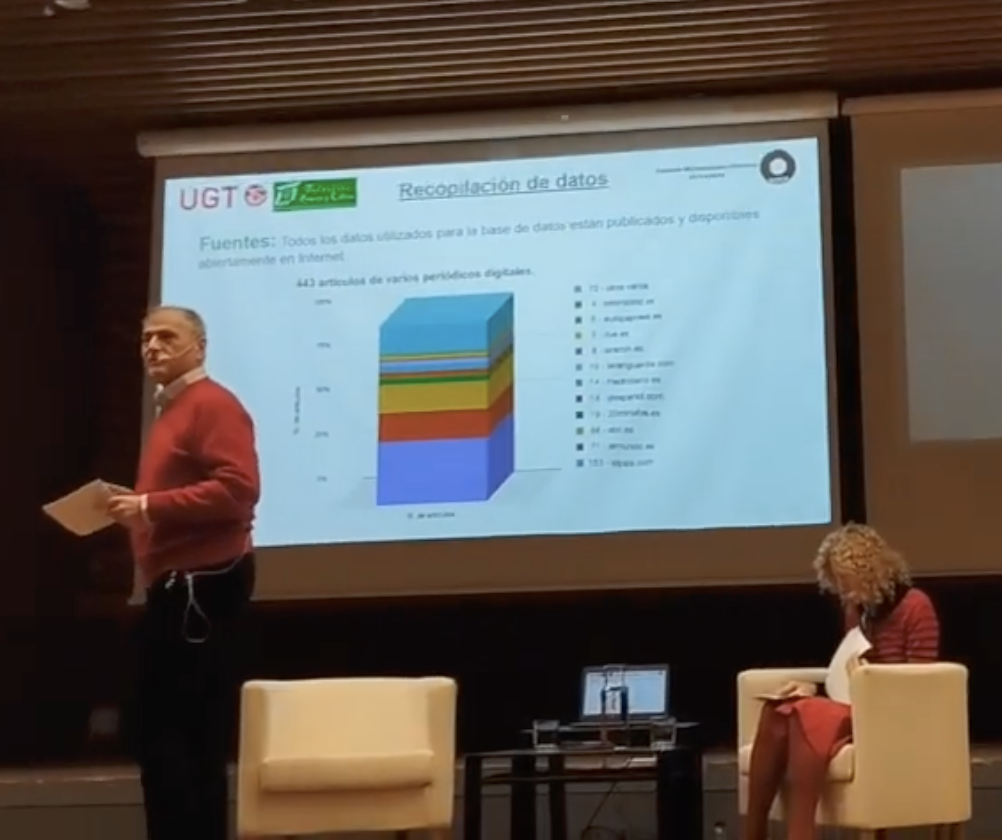
This is a masterclass/session that clarifies the reality of gender-based violence in a direct and open manner, providing tools so that both men and women can identify situations of abuse, as well as micro-abuse. The goal is to foster healthier relationships and to detect complex cases at work, among colleagues, and friends. The workplace provides the perfect, indirect environment to prevent violence that occurs at home.
Sequence: a)-Signs and indicators that can help identify whether a woman—even without physical blows—is in a gender-based violence relationship that poses a risk to her life, or whether a man is unintentionally exercising violence. Using a checklist of indicators, accounts of real cases (featured in the book) are thoroughly read and examined in all their different manifestations. Out of the 10 indicators covered, two are addressed per 45-minute period. This can be structured into 5 sessions of 45 minutes or 3 sessions of two hours.
b)-Patterns: understanding how violence occurs helps make sense of a reality frequently covered in the media. Throughout the development of the research, patterns began to emerge. This reveals, for instance, two critical danger elements: first, if there is a pattern of abuse, the aggressor may go too far during any given incident; second, the moment of separation is highly volatile. c)-Myths: beliefs that create a distorted view of gender-based violence and consequently hinder prevention. These myths help clarify aspects that are often obscured. For example, the underlying motivation behind a gender-based violence incident is not an argument but a habit of abuse; viewing it as a simple argument normalizes the escalation of a disagreement into a violent event. Another myth involves the profile of the aggressor; the aggressor may well be an ordinary person with a job, who pays taxes and has a social life, but who operates under internal misconceptions of reality—such as the construct of fabricated consent. 1-2 Sessions.
The primary objective is to raise awareness about the complexity of gender-based violence; the second is to provide a comfortable and safe environment in which to address micro-abuses. The third objective is to offer qualitative information and documentation that focuses on the reality of gender-based violence rather than its myths. The goal of the session is to provide data that helps build a global understanding of the reality of gender-based violence; this is an audience that is not interested in art but rather in social growth and equality.
Employees of large corporations or trade unions; we have conducted these sessions with UGT, Madrid.
The presence of two members of the MOSIS team: Jana Leo (philosopher) and Sergio Tombesi (data analyst).
The fees are standard for a lecture or conference.
The base price for the session is around X euros (for the duration of the grant, sessions have been offered free of charge), though quotes are tailored to each request. For the cost of the expanded workshop, please inquire.