The Art Resort

Description

The Art Resort Concept (Jana Leo)
Description
Manifiesto
Museum models
The Rise of the Secondary Market and the Fall of Art
Description

The Art Resort

It is undeniable that art does not have a significant impact on intellectual progress nor does it exert much influence on real life today. But why? What is going on? The Art Resort attempts to answer these questions.

There are two approaches: one is an analysis of current art models and systems, along with proposals for new ones; the other is an analysis of how the art market works, seeking to explain why it is a non-lucrative industry for its main player, the creator.

One problem in the art market stems from the difficulty of evaluating art and distinguishing between what is art and what is not at the time it is created. The resale market for established collectible pieces (the secondary market) does not face this problem; the trend so far has been to offer mechanisms for validating art through experts, curators, or auction houses by creating fairs such as Frieze. The strategy has been to validate the primary market so that it becomes part of the secondary market, which does not suffer from the problem of validation. This has been called promoting “new values.” But the problems arising from this strategy are growing exponentially; it is not only that the art being sold is limited to what is validated—which is already scarce—but also that art lacking validation has been automatically removed from the market, since the sole criterion for sale is third-party validation. The consequences are the suppression of the primary art market (the direct exchange between those who want art and those who produce it) and the fact that the secondary market does not reflect reality (auctions, when they support new works, end up supporting the old, and curators follow an exclusive line). The consequences for artists are that they have no market in which to sell their work unless they are selected, and for a country’s artistic heritage, as artists either stop creating art or leave.

Visit: La Revista Sauna 14 y Sauna 15

The ‘ART RESORT’ Or the story of the non-art passing itself off as art

Synopsis

It is indisputable that art does not have a major impact on intellectual progress or much influence on real life today. But, why? What is happening? The Art Resort tries to answer these questions.

On a small scale, what happens in art is the result of the model, which, in turn, is the result of something greater: the market for the intangible. The history of the conversion of the intangible to the tangible (e.g. an idea to a drawing) is as old as civilization, and it is always a difficult operation. During the last twenty years converting the intangible to the tangible, for commercial reasons, has focused on the abstract and has expanded into new fields. Traditionally, the intangible, by way of advertising, was objectified in the form of basic goods (like food or drink) or luxury goods (like clothing, houses or cars). In this way, Coca-Cola bubbles evoked happiness and the car moving through the landscape, freedom. Now, the intangible only results in other intangibles, which are almost impossible to realize. In this way experience becomes travel, thinking becomes meditation and wellness becomes relaxation. It is the market of the intangible squared. This new market is focused on leisure and culture. In this way, we can explain the way the art center in recent years has followed the model of tourism and has become an art ‘resort.’

In this context, The Art Resort tells the story of the struggle between non-art and art. And in the story non-art is winning so far. The book describes the elements and strategies employed by art in order to clarify what is not art, but attempts to pass itself off as art. This ‘civil war’ of art has consequences not only for art and artists (which is of little interest and affects very few), but also for the residents of the place where the struggle is taking place. The city is the battlefield. The Art Resort tells the story of the redefinition of what constitutes city.


Description by chapter

The first part of the book, comprising the Models of Separation and Systems of Production and Systems of Ritual, concerns itself with the tourist resort model applied to the museum, both on a large scale – comparing this particular tendency of tourism with art (Chapter 1), and on a small scale – breaking it down into categories and analyzing the individual components (Chapter 2).


Chapter 3, Is This Art? is an attempt to define the subject art by setting out a series of attributes. The definition of art is reached from an instrumental perspective, rather than from an essentializing perspective, that is, from the defensive position that art takes against the encroachment on its territory. Thus, this chapter serves as a kind of parenthesis between the first and second parts.

The second part focuses on the relationship between art, work and money. Within this section, Chapter 4, Art and Money = Art and The Market, answers the question of why other markets function well, while the art market does not. Chapter 5, Art and Money = Art and Work, deals with the strange relationship that art maintains with work and money. This section offers a theory as to why these relationships have come into existence, and what the consequences have been for the artist.

Chapter 6, Satellites and Secondary Structures, lists a series of practices and their supplementary parts (universities, artists’ collectives, non-profit associations, autonomous social centers etc.), which orbit like satellites around the main structure of the museum, and explain how they each have their own concerns.The last part, Everyday Revolutionary Actions, is a selection of my projects, letters and texts on art about art.

Existent and desired, proposal for a different model of museum


existent desired
System productivity

production

ambiguity

transformation

Object piece-machine gift-object-affective
Proposal project-future situation-present
Artist author-reacts-figure generator-activates-vehicle
Public visit-consumes passer-by-distributes
Curator (care-taker) procure-intention-selects simbiosis-forms bonds
Curator (guardian) manager-chooses and controls relate-mixes-connects people/things
Conservator (collection) preserver- keeper-custodian restaure to life-insert the collection
Place center plaza


museum existent

the museum in the city

desired

the city in the museum

Building The museum building creates identity The museum creates city
Space public art: located outside the museum, outdoors or in public space civic art: it has public interest independently of the space it occupies
Object Art absorbs other disciplines and transforms them into objects Art inserts its strategies into areas of real life
Function leisure: the museum opens at night or for hours at a time professional life: the museum acts as a link between different people. Art from 9 to 5
Content Spectacular, like statues, monumental Invisible, interstitial, intangible
City Accumulation of people

Tendencies

Habits, fashions and trends

Civic (citizens)

Civil (legislation)

Civilization (culture and art)


Staying within the limits of the familiar and away from the unknown is not simply a personal choice – that of sacrificing excitement and adventure for fear. Rather it is a political act since it avoids the identification with the other and opens up a gap for cruelty and injustice. Beyond family bonds, the city enables significant exchanges between strangers. Art understands reality as a whole, unifies form and content, presents facts without separating them from the affects they are bound to, and in doing so, withstands dehumanization.

The impulse to found art and cultural centers may be a response to the intention of creating cities through art. But just as vacation resorts separate tourists from the local reality, and don’t allow for cultural exchange, the art center isolates art within its discipline and separates it from real life, it does not create city. Thus, the art center functions as an‘art resort’: well-known artists, and fleeting stars, exhibit their work without context. It’s a window-museum, a controlled view of international art; exhibitions drift from one art center to another without relating to the environment; a wide selection of recreational activities are offered to the visitor in an isolated enclosure. Public art is an excursion – there is movement and interaction but no connection. The art, in the ‘art resort’, is like the tourist that enjoys the local customs without touching the reality of the place; the tourist doesn’t expose himself to the risks of travelling; he merely exhibits himself. Two subjects that coexist without coming together are protected but do not enrich each other. Isolated, art loses its nutritive properties; it does not generate city. It breathes in an urban context that suspends progress. In this way, the ‘art resort’ is a model of art production.

The skin is separated from an animal’s body only when it is already dead and has become merely a product for exploitation. The center, production, the commissioner… This is military and mercantile terminology that forms a language of control. But the beginnings of artistic creation are about ambiguity and reflection, as expressed in the myth: Perseus kills Medusa using his shield as a mirror. Separation: the work of art becomes a mere piece, a part in a machine. The project, a method that art has appropriated from architecture, which separates the creative process into conception and realization; the work of art isn’t created, it’s produced; instead of works of art there are projects. The present time deferred to the future loses intensity. No real exposure, just showrooms. Works of art continue to be viewed live in the galleries, but as at a funeral, only the body is present.

A present, as in a gift, is defined by its ‘presentness’, in that moment of exchange. Unlike the fetish object, in a gift there is no projection. As opposed to a product, the gift is ambiguous and uncertain; it has an objective cost and sentimental value; it is valuable but not in a quantifiable way. As opposed to the production system, the gift is indirect and not linear; it is based on mutual recognition and implies commitment. Even if it is in response to an invitation, it is a surprise. A gift requires interaction; it is not acquired, but given or received.

Seven models for the definition of the ‘art resort’. Field work, 2009

Art is a necessary product; it is a response to the human need for the existential, the emotional and the metaphysical. Faced with a need, an image is generated that eventually materializes in a work of art. At this stage there is always a disparity produced and the object falls short of the image. The main problem in art comes from the attempt to hide this disparity. In this way, museums glorify art and crafts, removing the abstract element in order to mask the percentage of failure or the fallibility of the artist (the reality of art is never true to the original concept). But this failing is inherent in all processes of translation.

The following is a conceptual map with the models that I have formulated from the places that I know and visit often. Below is a written outline

  1. Outlet model / feria de arte: Frieze Art Fair en Londres, ARCO y Just Madrid en Madrid
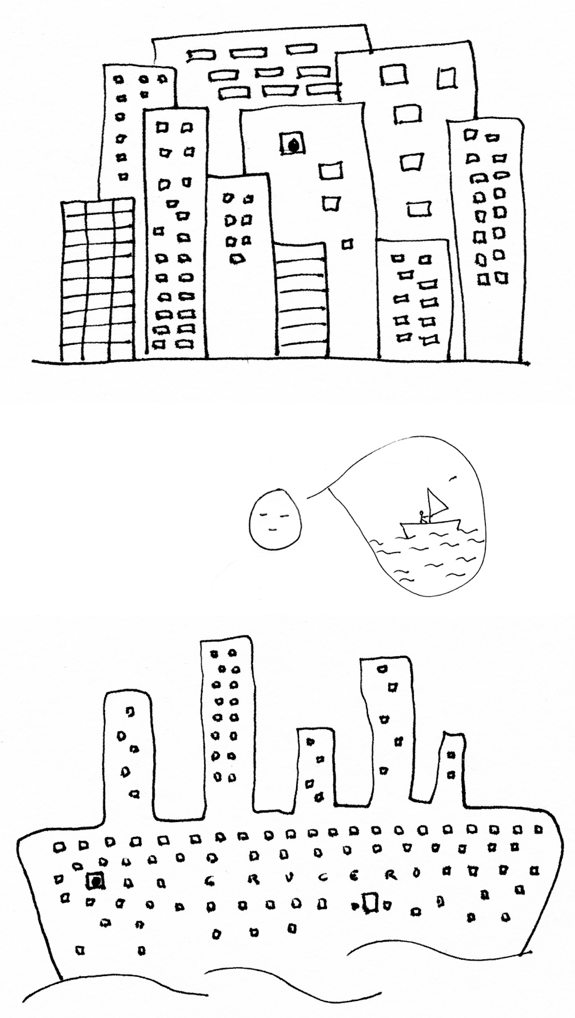
  2. Cruise model / centro cultural: La Casa Encendida en Madrid, CCCB en Barcelona
  3. Station model / centro de arte: Matadero Madrid
  4. Mall model MoMA en Nueva York
    Adaptaciones del mismo
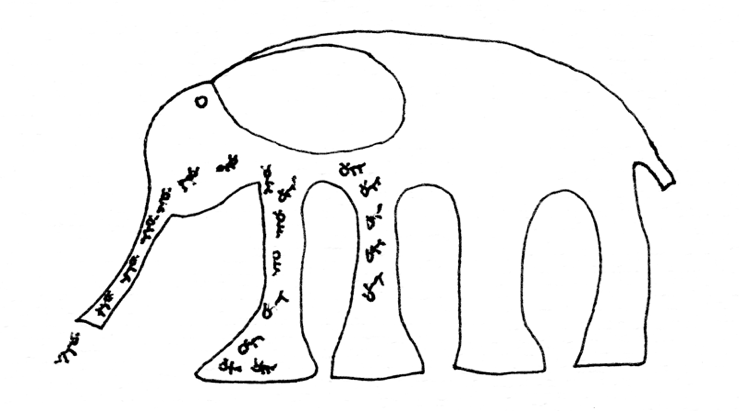
    *Elephant model, MACBA en Barcelona
    *Airport model, MNCARS en MAdrid

Please note: this text was written in 2009 and many transformations have taken place in the Spanish institutions that appear here, such as La Casa Encendida, the CCCB and the Matadero, since the change of government in 2011.


  1. Outlet model/feria de arte

[Frieze Art Fair en Londres, ARCO y Just Madrid en Madrid]

The 2009 edition of the Frieze Art Fair in London was presented in the following manner: “The Frieze Art Fair features more than 150 of the most interesting contemporary art galleries in the world.”

<http://www.friezeartfair.com/visitors>.

The emotional-observation experience

The fair takes place in Regent’s Park, in a fairly central area of ​​the city. The Frieze Art Fair is heralded as an exciting event. What is special about this show is that the artists are alive and young. It’s like being on a safari in Africa among lions, just that here the tourists are getting up close with artists. This is not a permanent installation, rather a marquee set up for the occasion. The space is hostile, despite being next to a park; there is only natural light in one wing, the floor is temporary stage that amplifies every footstep; it is a poorly heated, cold place; the bathrooms stink. The floor plan of the fair is labyrinthine and the aisles are overcrowded. There are very few places to rest. The galleries are small; there is a pavilion that serves as a conference room. The majority of collectors, gallery owners and guest speakers are staying at the same hotel, Langhan Place, ten minutes from the fair.


The conceptual model

The Frieze Art Fair functions as a flea market of brands, an outlet. An outlet gives priority to what is sold over the place where it is sold. Brand names but without the glamor; the object is validated by the name. The outlet, unlike the boutique, doesn’t have spatial identity; it can be set up in empty stores for rent, where there is no sign of previous business. This is the fundamental difference between a fair and museum: at a fair, the importance lies in the name of the artist, while at a museum the priority is the venue. There is also variety in the components: in many cases, objects of a high quality are sold alongside those that are practically worthless.

Outlet is also used to refer to an electrical wall socket where various devices can be plugged in; the fair also embodies this sense of ‘plugged-in’: it is a place to make connections.

The crowd is mixed; it mostly consists of young investors who are attracted by the excitement the show offers. At night, the atmosphere is like a decadent party, and it is not immediately clear that they are there because art is on display, and that it is not, as it appears at the hotel bar, a brothel or a luxury swingers club. At the main entrance two girls with sandals and fur coats are smoking:


“Hey, do you want to buy some art?”

“Sure.”

“How much you got? I like your silver shoes.”

“Twenty.”

“Ya, for that price I can give you a hot deal.”


There are two contemporary art fairs in Madrid that resemble the Frieze ‘outlet’ somewhat, ARCO, because it tries to sell brand name goods, and Just Madrid, because it tries to create a space that attracts a young audience.

Just Madrid associates itself with ‘emergent art’, hence the color green: young fruit, freshness. This fair is a perfect example of a place for networking, but in the worst sense – emerging artists trying to climb up towards the light. This so-called ‘fresh art’ is actually non-art trying to pass itself off as art: unripe art, immature and sadly pretentious. Note the name of the fair, with that little word just, already declaring its desire for understanding and globalization.

At ARCO there are stands giving away free Illy coffee; at Just Madrid there are cocktails, gin tonics or Heineken. It seems that at ARCO you should be wide-awake, and at Just Madrid, tipsy. At Just Madrid, everyone is slightly flushed with contented smiles on their faces, the effects of gin mixed with a green liquid. Under the influence of the cocktail the artwork looks better. The green of the cocktail matches the walls; green is also the color of the catalogs. It must be the sense of freshness that is associated with the green. But there is another meaning associated with this color: green fruit, unripe fruit, which gives a better sense of what is on display at the fair. Associated with this ‘fresh’ art, the cool green art is simply immature art. Green: as in harmless or inoffensive. Paradoxically, as art broadens its spectrum on a formal level (many things can be art), on an operational level it is separated from real life, which makes art more innocuous and insignificant in contemporary culture than it has ever been before. The very name, Just Madrid, sings of harmlessness, where the word just implies that it goes no further, it is a sign of ideological passivity, no promises made. Using English words in Spain adds to the meaning, it is like a slogan. The name of the fair, with the English particle just is part of a trend in which titles are written in English, as a sort of air of globalization to be ‘cool’, and have a ‘happy day’. They are works of art with good marketing strategies; the content is sometimes good, but the priority, in terms of the object, is always the packaging and, in terms of the setting, always a good atmosphere.

The type of clientele at Just Madrid is similar to that at the new ‘coffee bar/bakeries’ in Malasaña, where New York style brunch is served in a cool atmosphere with a kind of vintage décor. But copying only the frivolous elements of US culture is decadent, retro. It cannot be coincidence that the cocktails served at Just Madrid are all colorful: these cocktails are decadent in character and, just like the atmosphere at the Frieze Fair, not at all ‘punk-rock’, but somewhat goofy.

Young Spaniards travel a lot. They often return with something from abroad, but usually something frivolous, without depth, and they rarely take anything of their own culture with them. One could say that this feeling of inferiority about all things Spanish stems from the forty years of dictatorship that produced a post-traumatic disorder, whose consequences are the worship of all things foreign and the lack of confidence in one’s own culture. Spaniards welcome everything foreign with open arms, as a symbol of modernity, when actually they are importing outdated models, precisely those that were ousted by a very young and much more progressive Spanish Republic.

ARCO, at one point, not now, was the place to go to see international experimental art; Just Madrid, on the other hand, offers nothing of the experimental, and in fact presents itself as an ‘emergent art’ fair, very different from the experimental. Consider the difference: experimental art has the ability to contribute to progress, since experimentation is necessary to bring about change. In contrast, emergent art is art that has not yet established itself due to its youth, but that wants to come to light (emerge) or, in other words, climb up towards the light, it is ‘climbing art’. This emergent art does not search for expression and is not concerned with esthetics, it is simply unknown, either because it is young or for another reason. But neither youth nor novelty is synonymous with progress, neither can they be equated. Value can be given to young art but it should always come with a warning against its biggest danger: stupidity, a lack of knowledge that mistakes the unknown for the new.


  1. Cruise model / cultural center

[La Casa Encendida in Madrid and the CCCB in Barcelona]

The Casa Encendida in Madrid follows the cruise model, but it is a cruise that doesn’t move; it offers multiple activities and services, and its value comes from the range of options on offer, not from the quality of those options. Nobody would be more concerned about the quality of wood to be burned than of that to build furniture.


This is how the Casa Encendida defines itself: La Casa Encendida is an open, dynamic, social and cultural center funded by the Obra Social Caja Madrid; it is a space for the most innovative artistic expression, as well as courses and workshops on areas such as the environment and solidarity. The cultural program offers performing arts, theater, film, exhibitions and other expressions of contemporary creation. From the beginning, La Casa Encendida has supported young creators in developing their initiatives with programs like ‘Emergencias’, ‘En Casa’, and the Artists in Residence program. In addition, La Casa Encendida boasts a comprehensive resource center (library, media library, new archive and radio, photographic and multimedia laboratories), which is open to the public. < http://www.lacasaencendida.es/es/que-es >.

<http://www.lacasaencendida.es/LCE/lceCruce/0,0,73526_0_0%24P1%3D16,00.html>.

In fact, this text corresponds to the courses, not to the exhibitions, whose approach follows that of standard, accepted culture, although it is presented as subculture. The approach should be called ‘cultural tendencies’: something that doesn’t involve investigation or risk, something that is trendy because of its groundbreaking appearance.

A holiday cruise, even if it does not move, can be a paradise. But one can also feel trapped on a cruise. La Casa Encendida, a metaphor for movement and action, could also feel like a house on fire from which one cannot find the way out.  Its value comes from the variety and also in the number of people visiting. The model is similar to that of an open buffet, a lot of food is on offer and a lot is eaten, but there are no means by which to produce or cook one’s own food. The food served, much like the wood burned, is extinguished by necessity. This is acceptable only when it is clear that the aim is to provide, not to build.


The CCCB, Center of Contemporary Culture in Barcelona, ​​was once a charity or community center, La Casa de la Caritat. This center has established its reputation by offering a program that builds (low-key activities that are meaningful in the long term) and moving away from the charity model (offering activities or products for consumption in the short term). Inaugurated in 1994, it has become a place of reference, primarily to other art centers in Spain, such as La Casa Encendida or CENDEAC.

The CCCB is a social center, a meeting place and a documentation center. As well as fulfilling its role of documenting, it provides a space for research and the schooling of new artists. In common with La Casa Encendida it is a place that attracts young people. But in contrast, the CCCB has become a meeting place, attracting people with its cafeteria, which is strategically located at the rear of the MACBA, and with the very architecture of the building, which opens onto an interior courtyard. The openness and independence of each individual part of the building seems to reflect the role of each department. In other words, in contrast to the example of La Casa Encendida, the internal structure is neither hierarchical nor linear. Exhibitions do not have a theme, but rather they often refer to a situation, and the overall quality is very high. Exhibitions and events are treated with the same importance as permanent features such as the archive, research, thought and study. In addition great value is given to words, poetry and literature, not so much in its printed form (books) as in its relational form (organizing regular literary encounters, for example).


  1. Station model / art center

[Matadero Madrid]

Matadero Madrid aspires to give precedence to (though not always successfully) the construction processes rather than the objects themselves.


Matadero Madrid is a living and ever-changing space dedicated to the creative processes, participatory artistic education and the dialogue in the Arts. Conceived with a desire to contribute to discussion of the contemporary socio-cultural environment and with the aim of supporting the process of constructing the culture of today and of tomorrow […] At the same time, Matadero seeks to promote a comprehensive and multidisciplinary approach to creation, in all its forms, focusing on research, production, training and dissemination. A unique laboratory for experimentation and construction of new trans-disciplinary formulae.

<http://www.mataderomadrid.org/>.


The emotional-observation experience

The place is impressive, especially for those (older residents of Madrid or those who have an interest in photography and death) who saw the walls covered in blood and the cold stores hung with dead animals. Matadero Madrid is very conscious of this relationship between life and death; the first sentence on their website explaining what Matadero is says: “Matadero Madrid is a living […] space.” The renovation preserves the original industrial building without covering it up. In a cultural sense too, life and death inhabit the building, that is to say, works that are lifeless, such as imported exhibitions, space given over to design and fashion are together, for instance, with a one day fair of local organic goods.

The conceptual station model

There are two features of stations that make me think that some art centers, such as Matadero Madrid, are based on them: first, the station is the destination, but not the objective (no one visiting a city would stay for days in the station); second, the station implies a stop, in the sense of cessation of movement, the station is stationary, and it is the people who get on and off. There are some cases where the station itself becomes the objective of the trip, such as a ski resort in the middle of nowhere.

Matadero Madrid follows the model of the station: first, in the way it puts process before objective; second, because it is a place where one can ‘get off’ and step away from the movement of the city to reflect on it; third, because it allows connection with another place: Matadero Madrid aims to be a place of convergence; fourth, because it is isolated, there is nothing else in the area around the station; and fifth, because it is very ambitious in its role as an artistic complex: theatre, cinema, design, analysis, family-friendly activities, the environment, workshops for the disabled, etc. It presents itself as a center for creation, while in reality it is more like a center for culture, in the sense of a resort or a cultural resources center in the city. The quality of the programmed activities is similar to the quality of the food or products that are sold at a train station or airport.

  1. Mall model

[MoMA in New York. Variations: Elephant model, MACBA in Barcelona; Airport model, MNCARS in Madrid]

‘The mall’ is the basic model of the museum and a perfect example is the MoMA. “The architecture of the new MoMA, with its atrium and outdoor-like interiors, resembles ‘the architecture of the mall’. The location of art in MoMA follows the same logic that department stores use for the classification of objects: materials, techniques, uses. (Fourth Floor: Painting and sculpture; Sixth Floor: Special exhibitions – often the opportunities section.) […] Ideologically MoMA, like a mall, celebrates exhibitions in a very playful way  […] The mall’s principle is to give the buyer something extra, something in addition to the product bought: the lure of the display. The idea of  ‘an extra’ is embedded in ‘art malls’, such MoMA, the museumgoer not only gets entertainment, but acquires culture. The ‘culture’ of the mall supersedes culture.” The MoMA represents a model of the phenomenon of suburbanization of cities by ‘malls’ of modern art. So, although the architecture and contents of the MoMA resemble a suburban mall, the MoMA has still become an icon of the city of New York.

*Note: see complete description of the mall model in ‘Appendix 2: As a mall, I really like MoMA, Manifesto.’


Airport Model (a variation on the mall model)

In Madrid, the MNCARS, the Reina Sofia Museum, is like an airport, not just because of the entrance with its heavy security, but because of the constant feeling of being in transit and waiting for something to happen. There is a lot of information, but one has the feeling of being in a place lacking in identity. The airport is an unattended space, a place meant for passing through and waiting. In a way, it is an obligatory space, not a place. Like at the airport, this museum is disorientating. Not a positive feeling of disorientation, like someone having a wander in the park, but the feeling of panic of not being able to find the entrance or the exit (particularly in the extension to the museum, where it is not easy to find the lift or the stairs). The windowless extension contrasts with the many windows in the original building. The windows do not open to allow the city into the museum as in an airport. In airports, the only areas with views to the outside are the waiting areas by the gates where passengers access their planes. In the MNCARS, the only views are available in the hall of the section designed by Nouvel. It is the liveliest area of ​​the museum, and also the most commercial: the bookstore, coffee shop and concert hall. From there, there are views of the sky and the reflections of the movement of cars passing by.


Elephant model (another variation on the mall model)

The emotional-observation experience

An example of this model is the MACBA in Barcelona. Ultimately, a mall is no more than a collection of stores under the same roof, which, due to its size, has become an unwieldy giant. There is something monstrous about it, like an anteater made of ants. The MACBA building wants to be a symbol of its surroundings, but is it? Its presence reminds us of the story of what came before, what disappeared or what was got rid of: many homes were swallowed up by the museum building. It is a clear case of the urban vacuum cleaner, sucking in everything in its path and drastically altering its surroundings. The small tiles of all the small kitchens and bathrooms of the small apartments in the area have been taken apart and replaced by one giant wall of enormous, industrial tiles. The museum appears to be a standard, international bathroom with easy to clean walls. The MACBA has been given the task of cleaning up the neighborhood.

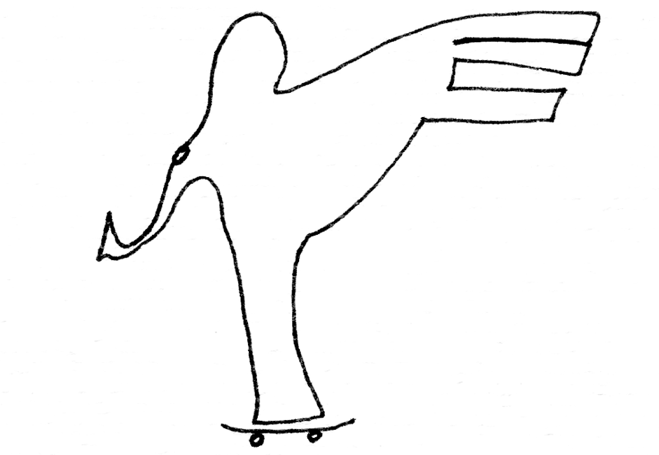
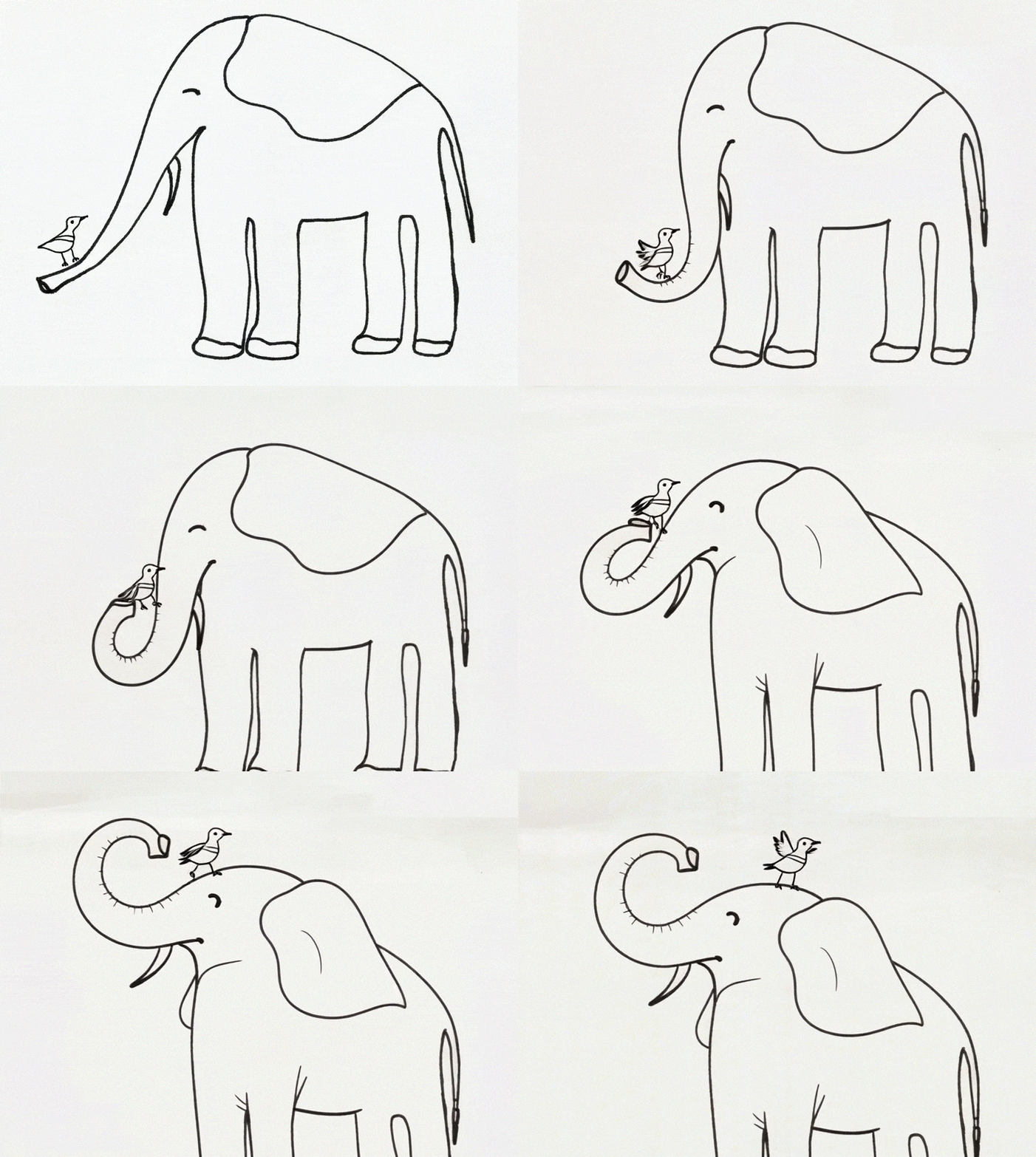
The building almost does not fit; it has been planted in the middle of the Chinese neighborhood in Barcelona, amongst narrow streets and tiny apartments full of stacked-up families. The building, an unwieldy giant, is an elephant; it is a circus elephant that has been made to jump through the impossibly small ‘hoop’ that is this neighborhood. There’s an elephant walking through the streets of the city, laying waste to everything in its path. The elephant has managed to squeeze through the gap and now there is an enormous white circus tent for the circus that is the MACBA. But this big top is empty; the acrobats live in the surrounding neighborhoods and fill the square with their skateboards. But, is the MACBA that dynamic? The elephant doesn’t skate, it hardly moves at all, almost as if it were dead.

The Rise of the Secondary Market and the Fall of Art

Economic activity
Economic activity is defined by any process through which products, goods and services that meet human needs are obtained. According to the definition of economic activity, that art supplies a basic human need it automatically turns art into an economic activity. However, an economic activity has to generate money for who performs it, because otherwise it would be a business that no one would engage in and it would disappear along with the social context in which it occurs.

Does art produce money for artists? Can art really generate money for a country or does it serves only to create the illusion that there is money? And how is the illusion created that there is money generated, is it through moving money around? In summary, does the art generate money or only shuffle it around?

To achieve a response, it is necessary to begin by re-asking the questions in a more rigorous form. Money is only an accounting unit: not caused by an activity, but is created from nothing by the central bank and the financial system as needed. A more accurate term in economics is “wealth.” For a country, its ability to meet the future needs of its citizens, it’s wealth is made up of several factors. The first factor is still exploitable natural resources. The second, exploited but not consumed natural resources, because they have been stored or have yet to be processed have real value because at a given time, they can be processed directly or indirectly into consumer goods or exchanged with other nations for necessary consumer goods. Many of these assets in turn become “artificial means” with the potential to increase a country’s ability to meet the needs of its citizens. An example might be investment in productive capacity, facilities and industrial machinery, provided their products meet a real need and demand of citizens. The third factor is the active population, its relative amount, ability, preparation and creativity. The fourth factor is, the skill, dexterity and judgement that the work of the population is applied to the exploitation of resources. In a modern economy, this can mean several things such as economic policy pursued by the authorities, the quality and strength of institutions, the ability of society to create and innovate, the type of economic system adopted, etc.

Translated into art, these factors are firstly, exploitable natural resources which would be the raw material used by the artist; exploited natural resources but not consumed, the work of art will be the second; the third, the number of artists and the fourth, cultural policies, cultural management and the market structure.

“Can this economical activity called Art actually increase the wealth of a country, or the money that moves around the art market is only a transitional means to facilitate the exchange of existent assets? ”

The market
The market is the real or virtual site where traders converge to offer their products and exchange them with others who need them. It is therefore the place where needs are met, where they are materialized with something specific that one can get in exchange of the product itself.

One could say that a market where all participants leave equally satisfied, while each take care only of their own need, is a well functioning market. Economists call this a “perfect market” because it allows efficient distribution of resources, maximizing the wealth of consumers and producers alike. This market does not seem to exist in reality but is a useful theoretical concept to measure the efficiency of real markets.

To what extent does the art market approaches the perfect market model? In essence, the art market is no different than any other market (a place where buyers meet sellers and exchange art pieces at an agreed price), therefore, the analysis starts with the general principles, later dealing with it’s unique complexity.

When art has a simple structure, it seems to be close to the perfect market model. Formerly, the artist was also a craftsman and lived in a market zone of the city with other artists and artisans. Customers visited the various workshops to find the artist who understood their needs and whom they liked aesthetically for the price they were willing to pay. This market can be defined as “direct primary market.” Such a market was conducive to direct contact between the producer and consumer of art, it encouraged competition among clients to hire the best artists and between artists to get the best jobs. This scheme is not far from the concentration of galleries in zones, in new York: SOHO, Chelsea or the LES where people walk and shop around; the only difference is the presence of an intermediary, the gallery now we are facing the “indirect primary market”.

For works that have some mobility, there soon began to establish a market of “second hand” or, to use an economic term, “secondary,” where the possessor of a work was able to sell to a third party not even know personally to the artist. The onset of this secondary market confirmed that a work of art can be a capital asset that is used to store wealth, and introduced a third type of trader: “the middleman”.

Since then, the art market structure has gotten more complicated but always maintaining this dichotomy of base; an study of the current situation needs to analyze this division of primary and secondary market. In this process, the actors in the market also have been multiplying, there have appeared several types of intermediaries. Today it is highly unlikely that an artist sells his work directly to a customer. The direct primary market has been giving way to an indirect primary market with art galleries and fairs as intermediaries, while in the secondary market, auction houses and private dealers have emerged.

The current market has a structure in which artists sell their work through galleries. The galleries represent (in some cases, invite, choose, and / or “discover”) the artists. They take on deposit their works and try to sell them to collectors. Through exhibitions at the gallery, writings of critics, the art pieces try became of value.. After a career of exhibitions, it is possible that the artist is selected for art fairs (the markets require that the artist has gallery shows in order to participate), which gives more value to the art. This may be the time when the artist is capable of choosing a gallery as their work is likely to be collected with ease. The artist has exhibitions in non-commercial art centers such as museums and art centers and may continue to have good reviews and those who bought the artist’s work, resell, entering it into the secondary market (auction houses and private dealers.)

In this structure, the most prominent agent has been the gallery, followed by the curator whose specific function is to select the most outstanding artists. In fact the role of the curator that seems to be purely cultural, produces a market jump for the artist, that is, those elected in the primary market are launched to the secondary. In this launching into the second market, the curator and the art center play a prominent role. A lot of stuff moves around the art center. We can speak of a third market that is not art but linked to them. A market of collateral activities-“promotional” such as exhibitions and catalogs, grants, educational activities, and tourist activities.

The secondary market is basically: an auction house. Increasingly art dealers and brokers are all trying to work in both markets. It is in the interest of auction houses, who charge percentage commissions, to increase the volume of work passing through their auctions, and therefore they participate or sponsor art fairs to promote and make known new artists, to promote demand for their works in the secondary market. Importance is given to the fairs in this game because buyers are willing to pay a higher price if they think they have the ability to resell a work at a profit. On the other hand, the galleries resent that auction houses receive the largest portion of the profits from their “investments” in new artists and collectors try to lure customers with discounts and rights of first refusal, asking in return be the first to be consulted in case of resale.
What role has the artist, the key player, in this whole market structure? Less and less, except for those artists who manage to reach the secondary market, they become stars, some of which, shooting stars, because they are interdependent on the continued support of the primary market.

Imperfections
In the primary market, the splitting of the direct link between artist and client has several practical implications from the point of view of relation to the model of the “perfect market.” Now the artist has no way of knowing the real needs of their client, whether existential, aesthetic or philosophical of nature, and hence, for it’s ability to be a concrete product that maximizes the satisfaction of the buyer. On the other hand, the client cannot communicate with sensitivity and creativity of the artist, has a similar difficulty in fulfilling its requirements for specific objects. The worst thing is that both know the price at which one is willing to produce the work and the other to buy it. Some of this information is unknown by the intermediary. The broker knows the needs of artists and clients and tries to match one to the other but maximizing their own needs. In economics, when a buyer and seller have different information on the same transaction, it says there is “asymmetric information” Asymmetric information can lead to a market inefficient macroeconomic performance and in some cases to its complete abolition.

So, to a gallery, it becomes extremely important to convince the buyer of the quality of a work of an artist to justify its price. But, by doing this, the gallery owner may require a significant investment that must be reflected in higher prices. The higher prices, in turn, reduce the market and establish a strict selection of the artists who are promoted. In addition there is the problem of how to define quality. A direct primary market does not have this problem: the quality is totally subjective. Put simply, the buyer chooses the artist who gives them what they want at the price they are willing to pay, and where poor execution does not earn or earns less. But in the indirect primary market, because of the asymmetry of information, the buyer needs to be convinced that the quality of what you propose is worth the price they ask and find some “objective” indicators of quality. How to value a work of art in an objective manner? Experts speak of historical, conceptual innovation, originality, technical mastery, but the most important factor is when there is a true consensus of experts and critics of these qualities in a work. So to promote artists, galleries and fairs try to raise the profile of and artist, looking to create a consensus among critics and experts on their qualities. The strategy is to minimize the risk, looking for a few potential winners and to invest in them, leaving all others behind. And the investment begins to bear fruit when the works make the leap to the secondary market. Therefore it seems that the structure of this market is likely to focus all resources on the validation of the artist to increase their marketing but not in creation.

Art Demand
There are two main types of demand: First one, out of necessity, and second one out of speculation.  In the demand based on need, one buys something because one needs it. The speculative demand consists on the purchase of works for inversion, buying something that is not needed, one buy it to re-sale.

Observations on the demand curve: the art centers, and museums that in theory should fuel demand for the art of necessity, in reality has become an instrument to the speculative demand. Their main task the validation of the artists, they offer a service to the secondary market.

The language that has developed around the arts center, like the emerging artist, or artist with projection specifically serves a function: validate an artist for the investor to buy, to help the artist reach the secondary market, that is to enrich speculative and not the existential necessity of art.

Second hand market

Re-adding the numbers of study can make the following distribution of expenditure:

2.40-5%- depending on countries occurs in direct primary market (new pieces  sold between artists and consumers). “20.00 to 30 % occurs in indirect primary market (new pieces sold through the galleries). 7-17.00% occur sin the secondary art market (market for the sale of works of art by artists considered as valuables, especially at auction houses). 60.60-80% occurs in a market to market collateral secondary (site management by government and private.)

These numbers generate many questions. Why the direct primary market is so small world wide? How to increase the primary market directly linked to the generation of works of art? What are the consequences of all of this with regard to artists and the production of works of art? How could the primary market in general and in particular the direct market be stimulated? The % dedicated to the collateral secondary market it is generating wealth or consumption only?

The secondary art market treat existing works which are recognized as assets. In this sense, this market does not create any wealth for a country, because all that happens is that existing wealth changes the environment in which it is stored: they sell bonds to buy these paintings, for example. Residually, it creates a bit of wealth in the sense that people working in this sector represents a human resource that consists of skills and knowledge that can be exchanged for other resources.

It is the primary market that creates real wealth for a country. In the primary market’s work is generated which has previously been defined “natural resources exploited .. but not used ..” which in turn may be provided by other “artificial means” such as museums and cultural centers to create more wealth. In other words, where works of art are generated?.

Why the direct primary market is so small? How to increase the primary market directly linked to the generation of works of art? What are the consequences of all of this with regard to artists and the production of works of art? How could the primary market in general and in particular the direct market be stimulated? How to make the market direct and not through intermediaries or those elected to serve for selecting art for sale? In short how to make the art market alive to function without hindrance?

Second hand market bring the idea of something used and not much value, that applies for clothes or homes, with the exception that special architecture or vintage, some with pedigree; now, think in the art market the option houses, this is second hand stuff.
market, that is to enrich speculative and not the existential necessity of art.

 [1] [1]    http://es.wikipedia.org/

[2] [2]    Human Scale Development 1991, Apex Press, New York and London, ISBN 0-945257-35-X

[3] [3]    A.H. Maslow, A Theory of Human Motivation, Psychological Review 50(4) (1943):370-96.

[4] [4]    Smith, Adam: An Inquiry into the Nature and Causes of the Wealth of Nations. AD. 1776.

[5] [5]    Traducción libre de “market. Encyclopædia Britannica. 2010. Encyclopædia Britannica Online. <http://www.britannica.com/EBchecked/topic/365647/market>

[6] [6]    Para profundizar el tema ver http://e.viaminvest.com/B10CompetitionInProductMarkets/App10PerfectMarketModel/Exhi_Perf_market_econ.asp

[7] [7]    In 2001, the Nobel Prize in Economics was awarded to George Akerlof, Michael Spence, and Joseph E. Stiglitz “for their analyses of markets with asymmetric information.”

[8] [8]    Akerlof, George A. (1970). “The Market for ‘Lemons’: Quality Uncertainty and the Market Mechanism”. Quarterly Journal of Economics 84 (3): 488–500. doi:10.2307/1879431.

[9] [9]    La dimensión económica de las Artes Visuales en España – Associació d’Artistes Visuals de Catalunya (AAVC).

The Art Resort